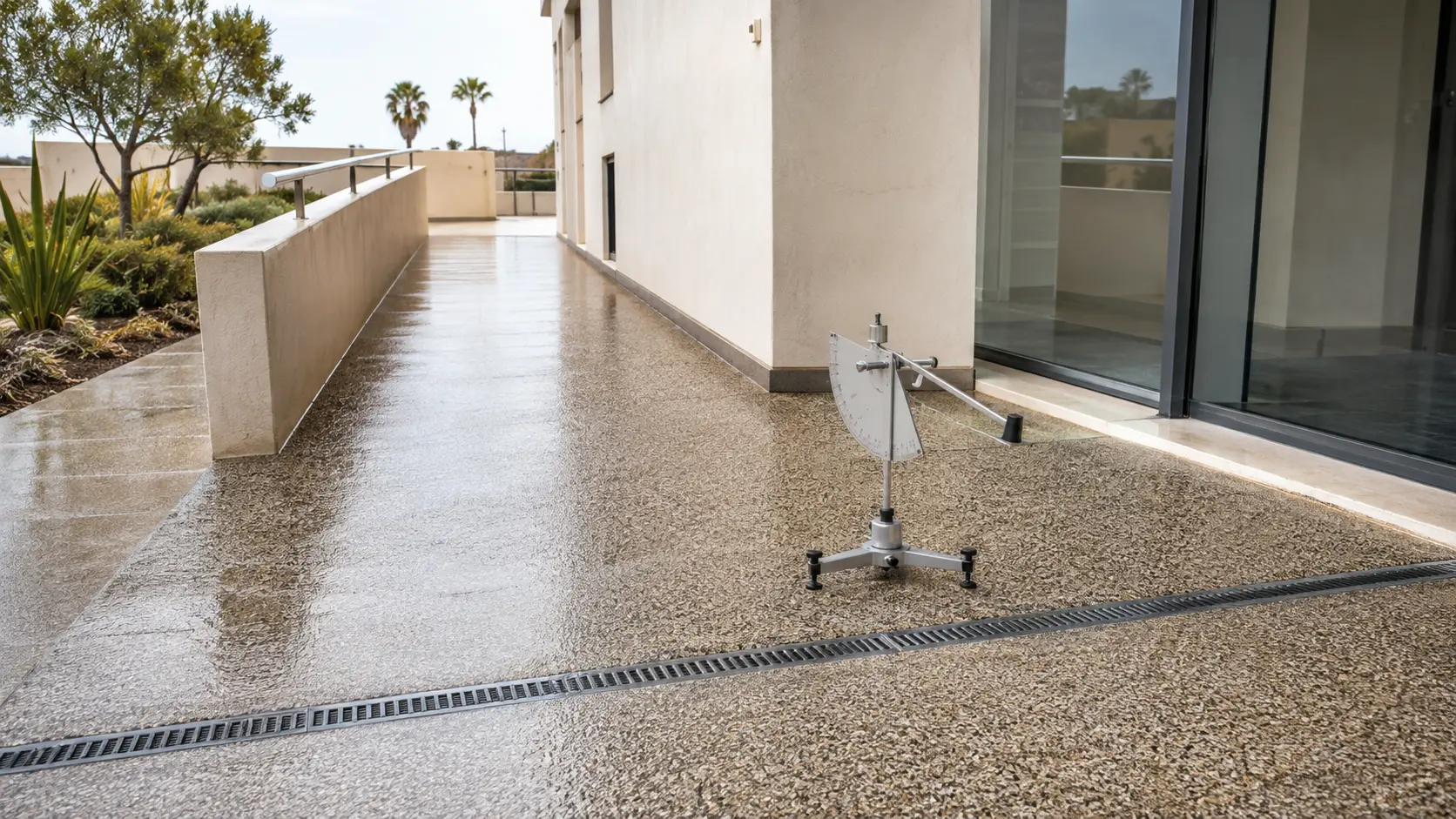
Resin-bound surfacing can provide a textured pedestrian finish, but “non-slip” is not a responsible specification. Slip risk changes with water, slope, contamination, footwear, wear, cleaning and the exact system installed.
For a private terrace, pool surround, commercial entrance or access ramp, the right question is whether the proposed surface has suitable evidence for that location and use. A general brochure claim cannot answer it.
Spanish building requirements may apply depending on the project and its use. Where a class or test value is required, the result must relate to the specified system and relevant test method. It should not be borrowed from another aggregate, finish or product.
Planning a wet or public-facing area? Send the project location, use, slopes and likely contaminants. We can help identify the documentation the specification should require.
Request a slip-resistance reviewIs resin-bound flooring slippery when wet?
It should not be answered with a universal yes or no.
The exposed aggregate texture can provide useful grip and many proprietary systems use a specified surface treatment to improve initial slip resistance. Water can pass into porous resin-bound surfacing, reducing persistent surface water where the complete drainage design works.
Neither feature eliminates slipping. Water may still arrive faster than it drains. Fine contamination can fill surface texture. Algae, oils, sunscreen, soap and cleaning residues can change the contact between foot and surface.
Suitability needs evidence for the actual build-up, location and condition in use.
Why “non-slip” is the wrong claim
No pedestrian surface remains slip-proof in every circumstance.
A dry test on a clean new sample does not describe a wet pool edge covered with sunscreen. A flat test panel does not reproduce a sloping entrance. A result recorded before trafficking may not establish performance after years of abrasion and cleaning.
Better language is specific:
- slip resistance tested by a stated method
- result for wet or dry conditions as applicable
- exact resin-bound system and finish tested
- intended location and slope
- maintenance needed to preserve the condition
If the evidence does not include those details, “anti-slip” is still marketing language rather than a complete safety assessment.
The Spanish CTE framework
Spain's Código Técnico de la Edificación, Documento Básico SUA, addresses safety in use and accessibility. Section SUA 1 deals with the risk of falls and includes slip-resistance provisions for floors within its stated scope.
The official DB-SUA text applies its floor classification provisions to buildings or areas used for public residential, healthcare, educational, commercial, administrative and public assembly purposes, subject to the document's scope and exclusions. It classifies floors by an Rd value obtained through a wet pendulum test described in UNE 41901:2017 EX.
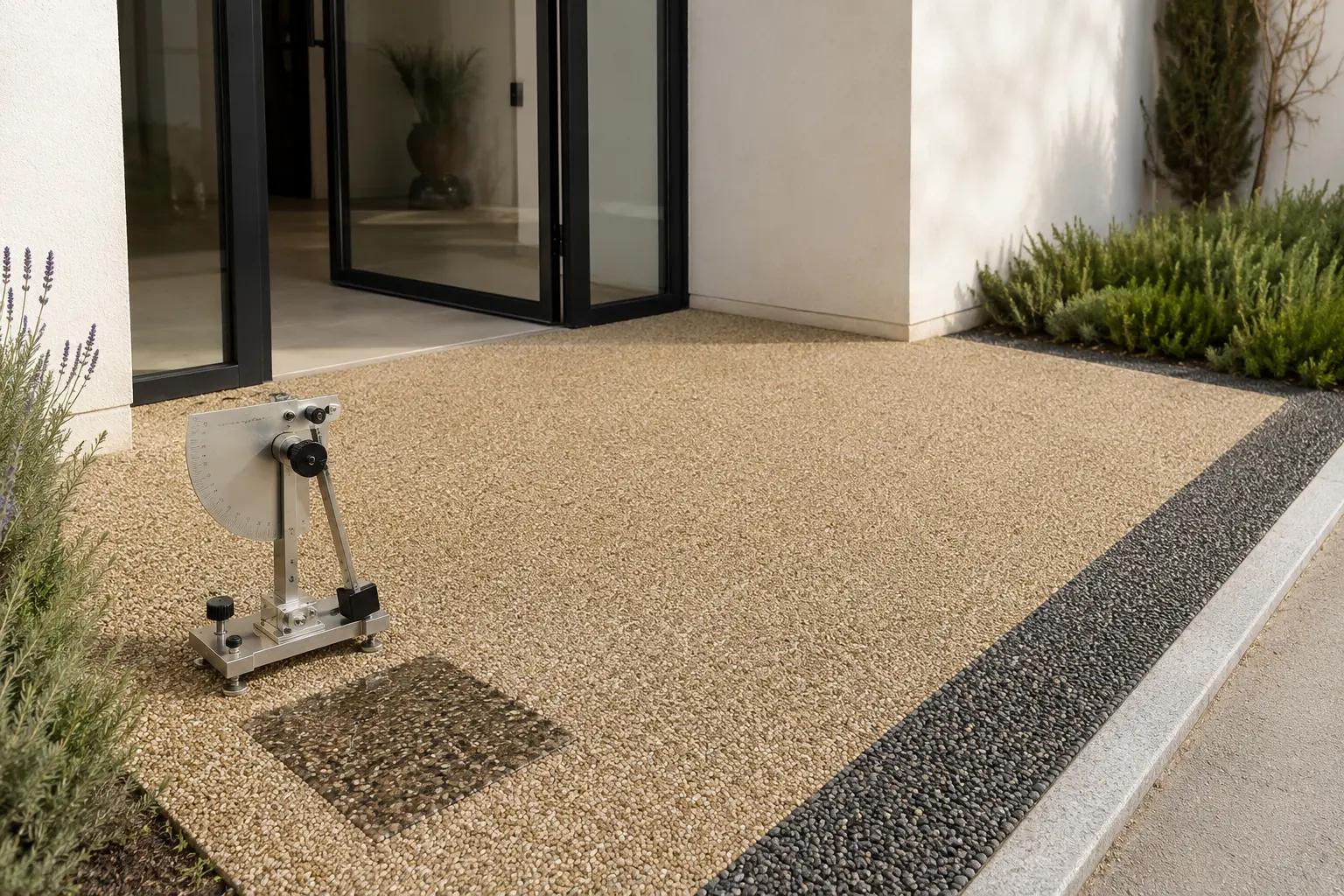
Within that framework:
- Class 0 is Rd up to 15
- Class 1 is greater than 15 and up to 35
- Class 2 is greater than 35 and up to 45
- Class 3 is greater than 45
The same document assigns minimum classes by location. It identifies exterior areas, qualifying swimming-pool areas and showers as Class 3 within the applicable uses. It also states that the required class is to be maintained during the life of the floor.
These figures should not be detached from the CTE's scope. A project architect or other competent professional should determine which provisions apply to a private home, refurbishment, community area, hotel, shop, healthcare property or public route.
Private homes and community or commercial property
A private domestic terrace should not automatically be described as legally requiring the same classification as every public commercial exterior. The CTE wording, nature of the work, building use and local approval route need to be considered.
The risk itself still exists even where a particular table does not apply directly. Pool users may be barefoot. Older occupants may need predictable footing. A steep private path with irrigation crossing it deserves a proper surface decision regardless of the minimum legal position.
Community pools, tourist accommodation, hotels, restaurants, shops and publicly used routes need closer review because their use and duties differ from a single private dwelling. Project-specific professional advice is appropriate where compliance is being declared.
Understanding a test result
A number without its method and conditions is difficult to use.
A test report should identify:
- testing organisation and report reference
- standard or method used
- wet, dry or other test condition
- exact product and aggregate grading
- applied surface treatment
- sample age and preparation
- direction and number of readings where relevant
- result and classification
- limitations or intended use
Different methods do not produce interchangeable numbers. A pendulum test value, ramp-test classification and manufacturer description cannot be treated as equivalent without a valid technical basis.
For a Spanish CTE declaration, evidence should align with the method and class required by the applicable document or be accepted through a properly documented equivalent route.
Product test versus installed surface
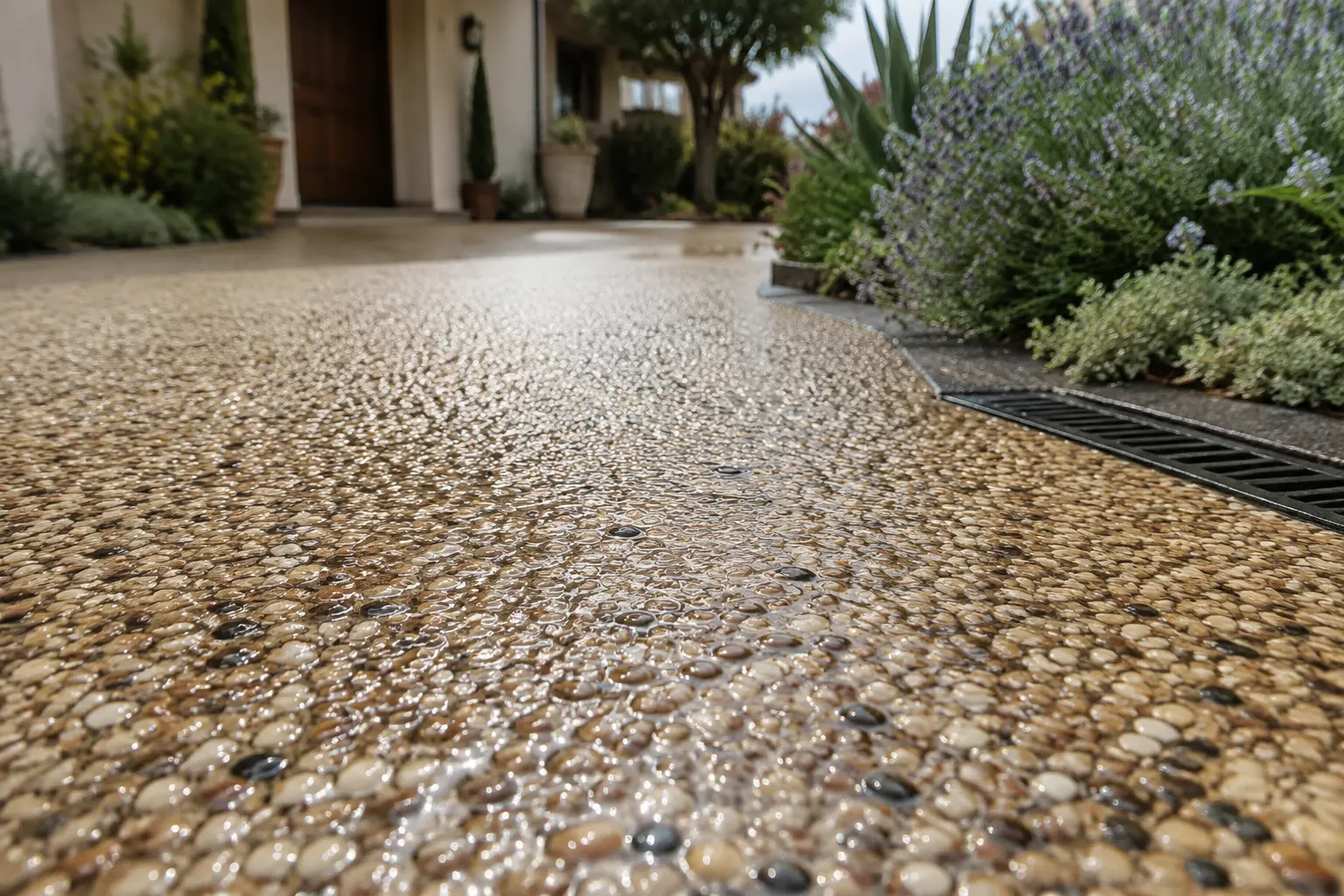
A laboratory or certification result can establish useful performance for a defined system. The installed surface still has to match it.
Changes that may affect the result include:
- different aggregate size or shape
- altered resin-to-aggregate proportions
- omission or excess of the specified surface treatment
- inconsistent trowelling and compaction
- a coating added after installation
- contamination during curing
- wear and maintenance after handover
The quotation should connect the named product, tested configuration and installation method. A test certificate for one manufacturer's 6 mm blend does not automatically validate an unrelated material assembled on site.
Aggregate texture and surface finishing
Resin-bound surfacing is trowelled into a controlled plane. Its slip behaviour comes partly from the exposed aggregate texture and partly from any compatible additional treatment specified by the system supplier.
Some manufacturers broadcast a fine glass grit or other approved material onto the fresh surface to improve initial slip resistance. Type, application and compatibility matter. An improvised scatter can change appearance, feel and performance.
More texture is not always better. A very rough finish may be uncomfortable for bare feet, harder to clean and less suitable for wheeled access. The design has to balance slip resistance with the way the area will actually be used.
Pool surrounds
Pool edges present changing conditions throughout the day. Users move between water and dry areas, often barefoot. Splashing, sunscreen, leaves, limescale and cleaning products can all affect the surface.
The assessment should look at:
- routes from the pool to steps, showers and buildings
- falls and drainage around the pool edge
- copings, skimmers, channels and covers
- areas where water repeatedly accumulates
- barefoot comfort under direct sun
- cleaning and water-treatment procedures
- supervision and intensity of use
The Spanish DB-SUA table refers to qualifying swimming-pool areas intended for barefoot users and to parts of pool basins within the stated depth condition. Whether and how it applies to the particular pool should be confirmed by the responsible project professional.
A porous decorative surface does not replace the other safety measures required for pool design and operation.
Explore resin-bound pool surroundsTerraces and patios
Private terraces may face intermittent rain, irrigation, spills from outdoor dining and organic debris from planting. Covered terraces can remain damp in shaded edges even when the central area dries quickly.
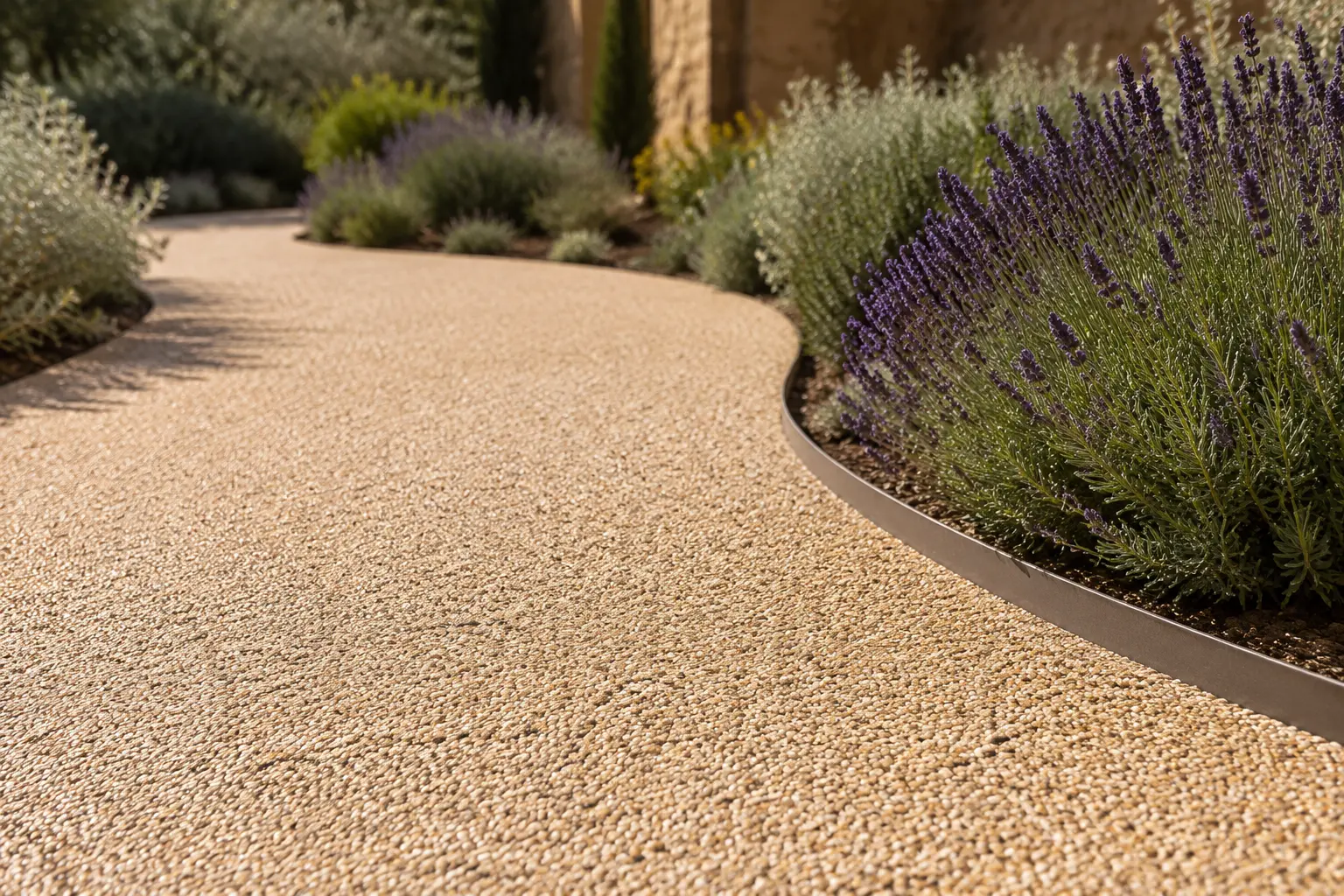
Important details include changes from indoor flooring, steps, door thresholds and any sloped route. A level-looking area with a low point can retain water and become a local hazard.
The blend should be judged for cleaning as well as initial texture. Pale rough surfaces beside soil beds can collect visible fine material, while a coating used to simplify cleaning may alter slip behaviour.
Explore terraces and patiosEntrances and commercial routes
Entrances collect water and contamination from outside. The risk can change within a few metres as users move from external paving to a covered threshold and then to an internal floor.
Commercial design should consider:
- expected footfall and peak periods
- rainwater tracked across the entrance
- mats, channels and door clearances
- slopes and accessible routes
- cleaning during opening hours
- deliveries and wheeled traffic
- lighting and visual contrast at changes of level
One test result for the external resin-bound area does not assess the entire transition. Interfaces and maintenance arrangements are part of the safety design.
Plan commercial resin-bound surfacingRamps and sloping paths
Slope increases the demand on the contact between footwear and surface. Water also moves differently, potentially crossing the walking line or collecting at the foot of a ramp.
The specification should record the gradient, direction of travel, exposure and user group. Handrails, landings, drainage and accessible-route requirements may also apply. Slip resistance alone does not make a poorly designed ramp safe.
Evidence from a flat sample may remain relevant to the material, but the complete project needs professional assessment where regulatory compliance or accessibility is involved.
Driveways and shared vehicle areas
Driveways combine pedestrian use with tyres, oil, dust and turning movements. A surface treatment selected only for barefoot comfort may not address this mixture of demands.
Pedestrian routes through parking areas should be clear where possible. Drainage should prevent water and contaminants collecting at gates, garage thresholds and routes to the home.
Fuel, oil and tyre residues need prompt treatment according to the resin-system maintenance guidance. A clean product test does not describe a contaminated vehicle surface.
Drainage helps, but does not prove safety
Porous resin-bound surfacing can reduce surface water when its voids remain open and the base or outlet can accept the flow. This can support wet-area design.
Standing water may still occur when:
- the underlying base is impermeable and has poor falls
- channels or outlets are blocked
- runoff arrives from a larger adjoining area
- fine dirt has reduced surface infiltration
- construction levels create a low point
- rainfall or splash exceeds the available discharge route
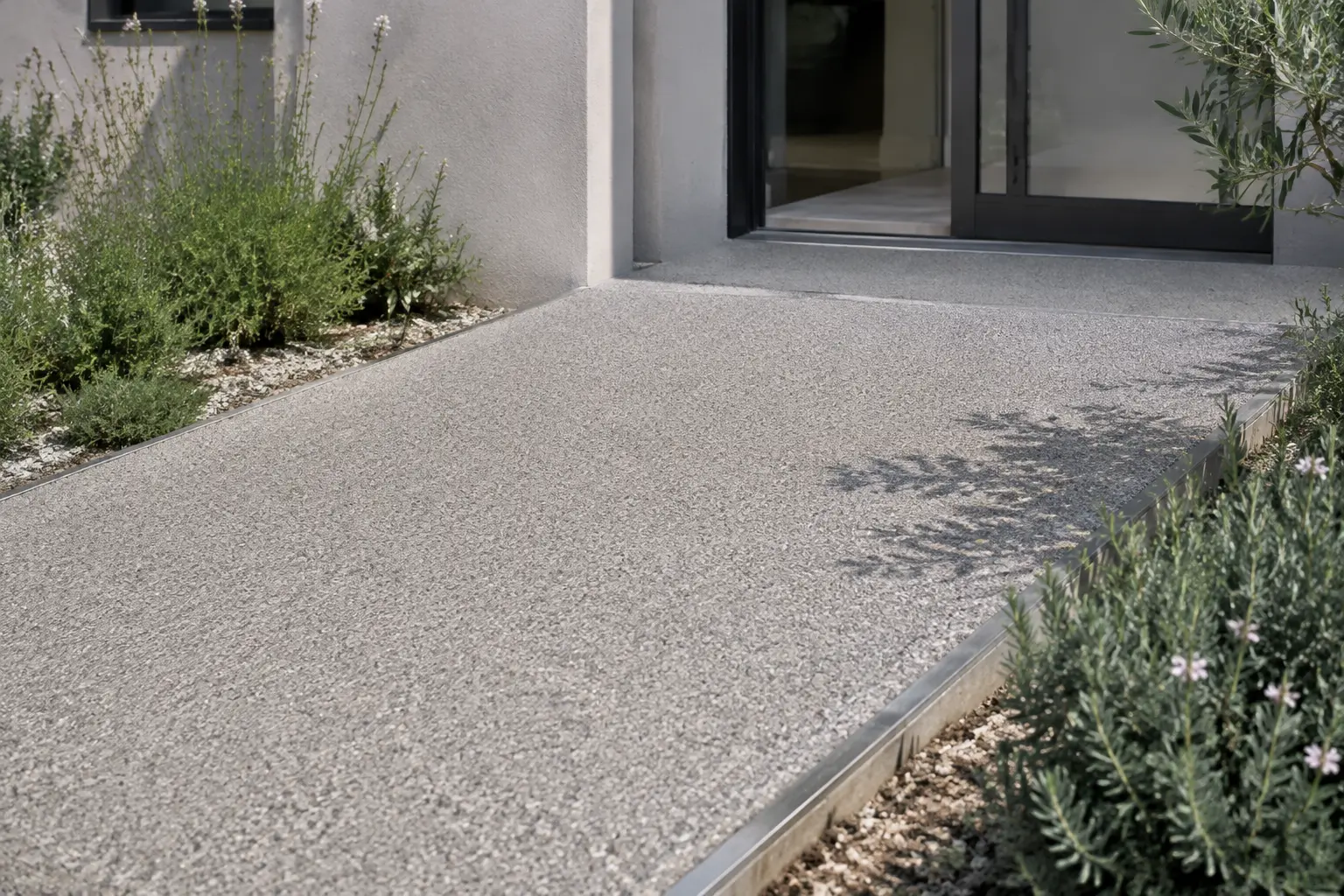
The surface and drainage strategy should be assessed together. “Permeable” is not a slip-resistance classification.
Understand drainage and permeabilityContamination changes slip resistance
Real surfaces are not kept in laboratory condition.
Common contaminants include:
- algae and moss in shaded damp areas
- soil and fine sand from gardens
- leaf residue and fallen fruit
- sunscreen and body oils around pools
- food oils near outdoor kitchens
- vehicle oil and fuel
- soap or detergent left after cleaning
- mineral deposits from hard water or irrigation
The maintenance plan should reflect what is likely to reach the surface. High-risk spills need an agreed response rather than waiting for the routine cleaning day.
Wear and the life of a surface treatment
Some manufacturer-applied slip treatments are most pronounced when new and wear with traffic. The underlying bound aggregate may continue to provide texture, but no assumption should replace the product evidence and condition of the actual area.
DB-SUA states that the required floor class within its scope is to be maintained during the life of the pavement. This makes maintenance, inspection and any necessary retesting part of the performance question, particularly for commercial or publicly used sites.
A handover should explain which finish was installed, how it is cleaned and when the owner should seek further assessment.
Cleaning without making the surface worse
Cleaning should remove contamination without leaving a film, polishing the texture or damaging the resin.
Use the specified system's maintenance guidance. Appropriate sweeping and controlled washing may be recommended. Aggressive chemicals, unsuitable sealers and excessive pressure close to edges can cause new problems.
After cleaning, residues should be removed and the drainage route left clear. A detergent that dries on the surface may reduce rather than improve safe footing.
Commercial operators should document cleaning products, frequency and incidents. The routine needs to work during occupied periods as well as after closing.
Coatings, rejuvenators and repairs
Adding a coating can change surface texture and the way water or footwear interacts with it. A rejuvenator intended for one proprietary system should not be assumed compatible with another.
Before treatment, establish:
- why the appearance or performance has changed
- whether the surface is contaminated or worn
- whether a compatible treatment exists
- how permeability will be affected
- whether new slip testing is required
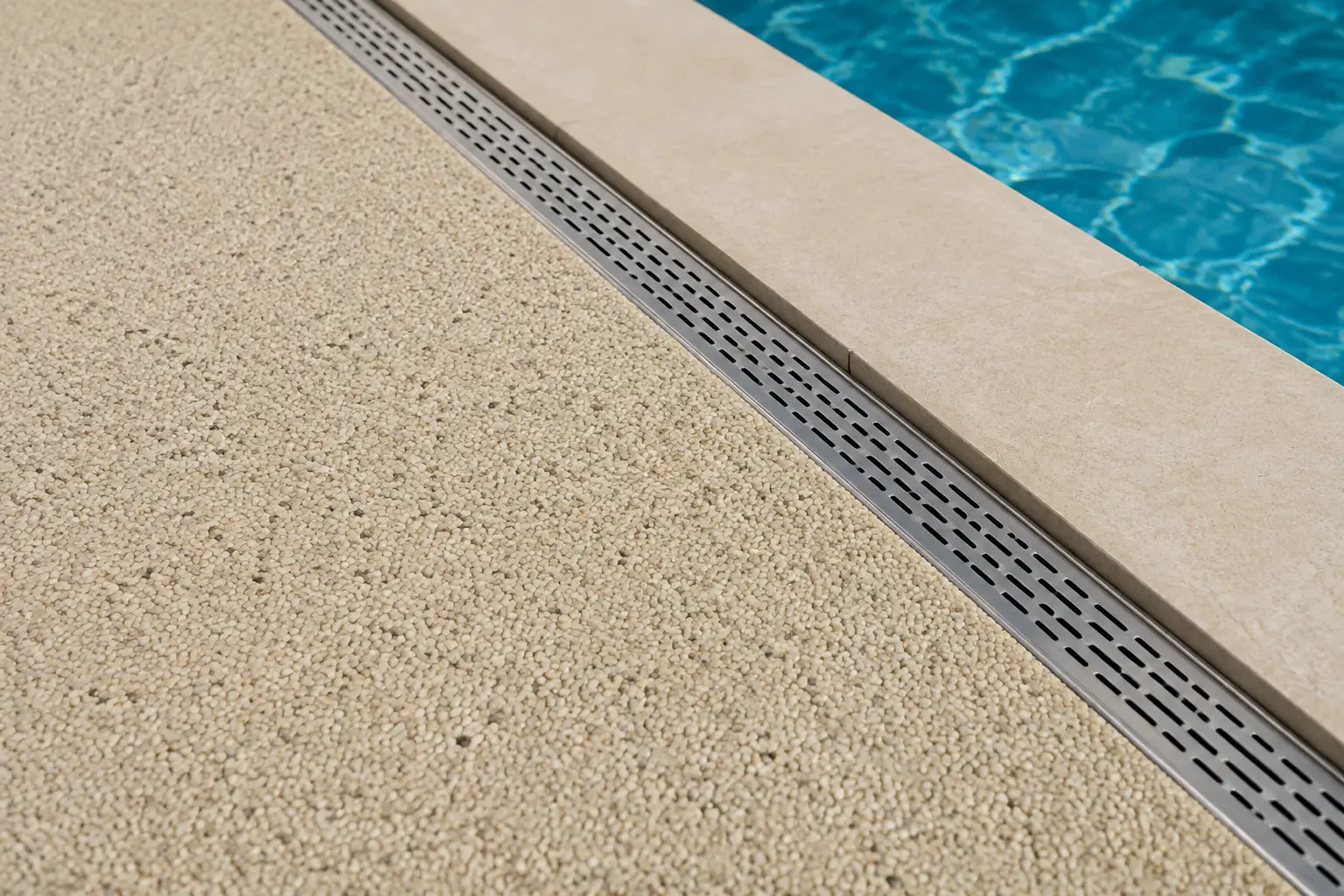
Local repairs may also create a patch with different texture. Where a regulated classification is important, the repaired condition needs to remain within the project's evidence and maintenance regime.
Heat and barefoot comfort
Slip resistance and surface temperature are separate aspects of wet-area suitability.
Dark aggregate in direct Spanish sun may become uncomfortable for bare feet even if its tested slip resistance is appropriate. Pale stone can reduce the visual and thermal intensity but may show dirt and mineral residues more readily.
Samples should be viewed on site and colour choice should reflect exposure and use. Do not accept a claim that any colour remains cool without relevant product and site evidence.
What a responsible specification should contain
For a safety-sensitive resin-bound area, the documents should identify:
- building or area use
- whether CTE or another project requirement applies
- required slip-resistance class or performance criterion
- test method and conditions
- named resin-bound system, aggregate and grading
- specified additional surface treatment
- slopes, drainage and expected contamination
- installation quality controls
- cleaning and inspection requirements
- responsibility for compliance evidence
The architect, specifier, installer, product supplier and owner may have different responsibilities. These should be clear before work begins.
Questions to ask before choosing a system
- What slip-resistance requirement applies to this precise area?
- Who has determined that requirement?
- Which test method and wet or dry condition are relevant?
- Does the report cover the exact resin, aggregate and finish proposed?
- Is the result initial only or supported for the intended service condition?
- What additional surface treatment is used?
- How will drainage and slope affect the area?
- What contaminants are expected?
- How must the surface be cleaned and inspected?
- Could later sealing or repair invalidate the evidence?
For commercial, public, community and accessible areas, keep the answers with the project records.
Request the evidence before installation
Slip performance is easiest to specify before aggregate is ordered and levels are built. Once the surface is installed, changing texture, falls or drainage can be disruptive.
Send the site use, photographs, slopes and wet-area details. We can help frame the product and compliance questions for the next stage of the project.
Request a wet-area review