
A continuous aggregate finish for villa entrances, private drives and selected commercial vehicle areas, designed around the base, slope, drainage and traffic.
Tell us about your driveway What makes a suitable drivewayA driveway is a complete construction
The visible resin and stone layer is the part that changes the appearance of a driveway. Its performance depends heavily on what supports it.
Cars place concentrated loads on the surface, particularly where they turn, brake or wait at a gate. A resin-bound finish laid over a weak, moving or unsuitable base cannot correct the structure beneath it.
Before choosing colours or aggregate blends, establish the condition of the current driveway, how vehicles use it and where rainwater is intended to go. These decisions determine whether the project may be resurfaced or needs deeper reconstruction.
Where resin-bound driveways may be considered
Resin-bound aggregate can be considered for:
- villa driveways and entrances
- parking and turning areas for private cars
- approaches to garages and carports
- paths and pedestrian areas connected to a driveway
- selected light-commercial entrances where the proposed construction is appropriate
The intended traffic must be stated accurately. A private driveway used by cars is not the same as a delivery area, refuse route or surface used by heavy service vehicles. Loading claims should relate to the complete specified construction rather than the appearance of the top layer.
Start with the existing driveway
Concrete
Sound concrete may provide a possible base for resurfacing after assessment and preparation. Active cracks, movement, poor drainage, contamination and damaged edges require attention first.
Movement joints and existing cracks should not simply disappear beneath the new surface without a considered detail. If the concrete has failed because the ground beneath it is unstable, an overlay is unlikely to solve the problem.
Can resin-bound flooring be laid over concrete?Asphalt
Some asphalt surfaces may be compatible with a resin-bound overlay if they are stable, suitable for the intended traffic and correctly prepared. Soft, deformed, contaminated or badly cracked asphalt needs closer investigation.
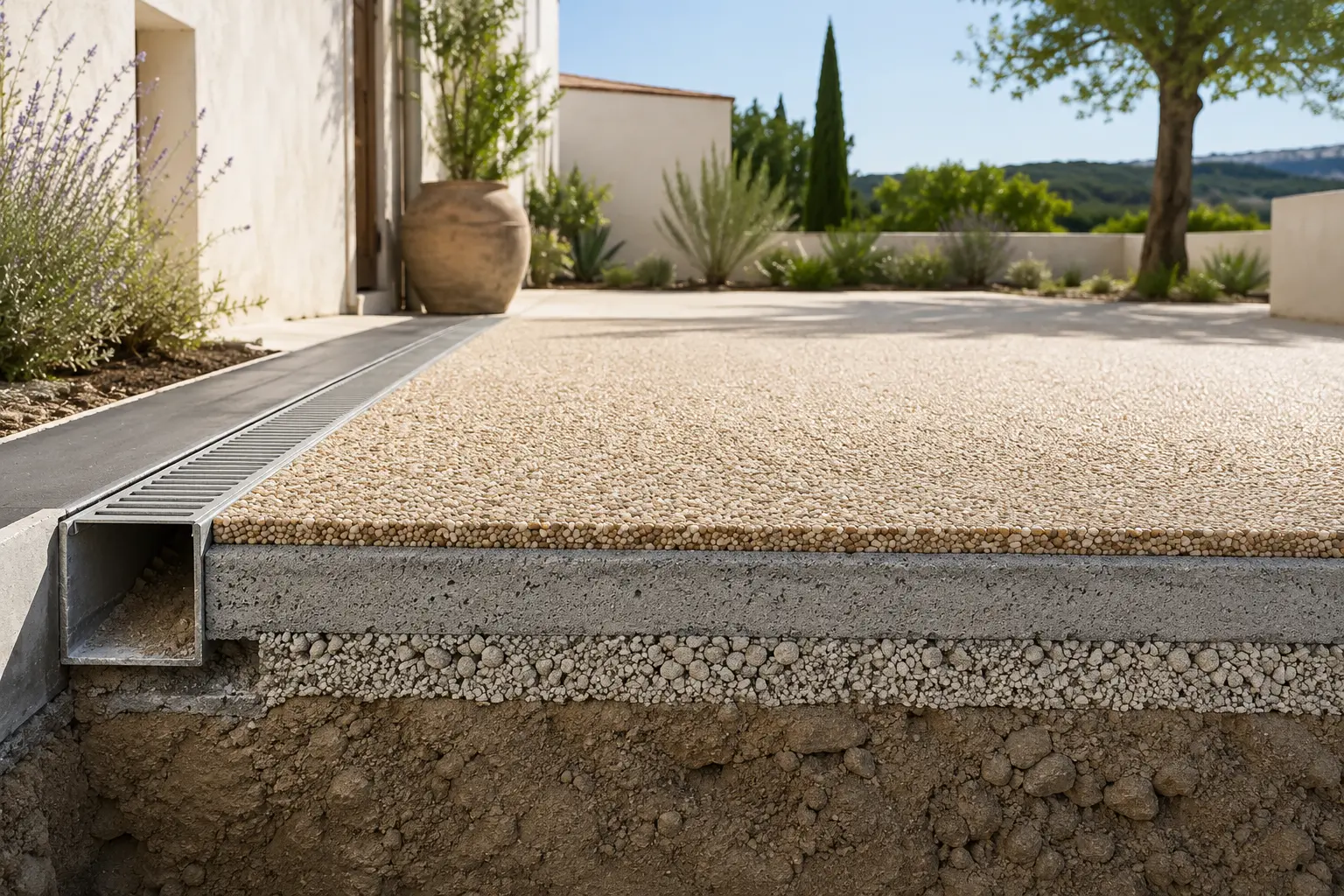
The edge detail is important because the resin-bound layer requires secure restraint around gates, drainage channels, planting areas and adjoining surfaces.
Tiles or paving
Exterior tiles and paving units can move independently, become hollow or hold moisture. A driveway also subjects them to loads they may not have been designed to carry.
An installer should not assume that a tiled entrance is suitable merely because it looks level. The condition and construction beneath the finish need to be established.
Can resin-bound flooring be laid over outdoor tiles?Gravel, soil or a failed base
A loose or undeveloped surface requires a new load-bearing construction before the resin-bound finish is installed. The excavation, sub-base, binder course, drainage and edge restraints should be designed for the site and intended vehicles.
The cheapest-looking quotation may omit this work or describe it too vaguely to assess.
Substrates and ground preparationGates, slopes and turning areas
Spanish properties often have sloping entrances, narrow gates and limited turning space. These features change how the driveway is used.
Vehicles may brake or accelerate on the incline, turn sharply immediately inside a gate or stop repeatedly in the same position. Water can also run quickly towards the street, garage or property if the levels are wrong.
The site assessment should record:
- the gradient and direction of the slope
- where vehicles turn and reverse
- the gate opening and wheel tracks
- garage and pedestrian thresholds
- drainage channels and discharge points
- access for preparation and mixing equipment
A continuous surface can make a complicated entrance look more coherent, but the construction still needs to respond to these concentrated loads and fixed details.
Drainage and permeability
Resin-bound surfacing is often described as permeable. This may be true of the finished layer while the base beneath it remains impermeable.
A fully permeable driveway requires a compatible construction and somewhere for water to infiltrate safely. An overlay on existing concrete or dense asphalt will usually rely on designed surface falls and drainage instead.
The proposal should explain which arrangement is intended. It should also deal with channels at garage doors, public pavement boundaries, retaining walls and any area where water currently collects.

Permeability is not a substitute for drainage design.
Drainage and permeabilityExterior resin and Spanish sunlight
A driveway can spend most of the day exposed to strong sun. The proposed binder should be suitable for exterior use and its colour-stability claims should be supported by the manufacturer’s information for that product.
Aggregate colour affects the appearance of dust, tyre marks, leaves and oil contamination. A very pale blend may require more visible cleaning in a vehicle area, while dark aggregates can create a stronger contrast with surrounding walls and paving.
Ask to view physical samples outside. Colours selected from a screen or indoor board can look different under direct Spanish sunlight.
UV-stable resin in Spain Colours and finishesDriveway edges and adjoining surfaces
The resin-bound layer needs a defined and stable edge. Existing kerbs, walls, metal strips, drainage channels or purpose-made restraints may form part of the design.
Particular attention is needed where the driveway meets:
- the public pavement or road
- sliding or hinged gates
- garage doors
- planting beds
- inspection covers
- ramps, steps and paths
- old concrete or tiled areas that are being retained
Poorly resolved edges are exposed to vehicle movement and can leave thin or unsupported sections. They should be shown in the proposal rather than improvised during installation.
Oil, tyre marks and routine use
Vehicle areas encounter oil, fuel residues, tyre marks, dust and wind-blown material. The maintenance requirements depend on the installed resin system and aggregate finish.
Spills should be dealt with promptly using a compatible cleaning method. Sweeping and periodic cleaning prevent debris accumulating in the texture. Any use of pressure-washing equipment or stronger cleaning products should follow the guidance supplied for the selected system.
No driveway surface is maintenance-free. The useful question is what routine care it needs and what happens if a section is stained or damaged.
Maintaining resin-bound surfacesWhat can go wrong?
Loose aggregate, cracks, lifting and localised failure can have several causes. Possibilities include poor mixing, unsuitable installation conditions, moisture in the materials, inadequate depth, a weak base, movement or incorrect preparation.

The visible symptom does not always identify the cause. A patch may repair local surface damage, but it will not stabilise a moving base. Repairs may also remain visible because new aggregate and resin can differ from a weathered surrounding area.
Why resin-bound surfaces crack, lift or shed stone Repairs and resurfacingHow much does a resin-bound driveway cost in Spain?
The difference between an overlay and a complete new driveway is substantial. Area matters, but the condition beneath the proposed finish is usually more important than a simple square-metre rate suggests.
Costs may include:
- excavation and disposal
- new sub-base or binder course
- repairs and surface preparation
- drainage channels and level corrections
- gates, thresholds and edge restraints
- the resin and aggregate system
- restricted access or complicated layout
- protection and return visits
A quotation should state what is being retained, removed, repaired and constructed. If those details are missing, two prices cannot be compared properly.
Resin-bound driveway costs in SpainQuestions to ask before accepting a quotation
- What is the existing driveway construction and is it being retained?
- What preparation or repair is included?
- What traffic is the proposed construction designed to carry?
- How will water be managed?
- Which resin and aggregate are being proposed?
- What installation depth and edge details are included?
- How will gates, drains, covers and thresholds be treated?
- When can vehicles return to the surface?
- What maintenance guidance will be supplied?
- Who provides any guarantee and exactly what does it cover?
Tell us about your driveway
Provide the location, approximate area, current surface and the vehicles that normally use it. Include any known cracking, drainage, slope or access problems and add photographs where useful.
The information will be reviewed before the appropriate next step is confirmed. Installation availability is not guaranteed in every part of Spain.
Submit your driveway projectRelated information
- What base does a resin-bound driveway need?
- Can resin-bound flooring be laid over concrete?
- Drainage and permeability
- UV-stable resin
- Colours and finishes
- Repairs and resurfacing
- Maintenance
- Costs in Spain
- Resin-bound flooring or printed concrete?