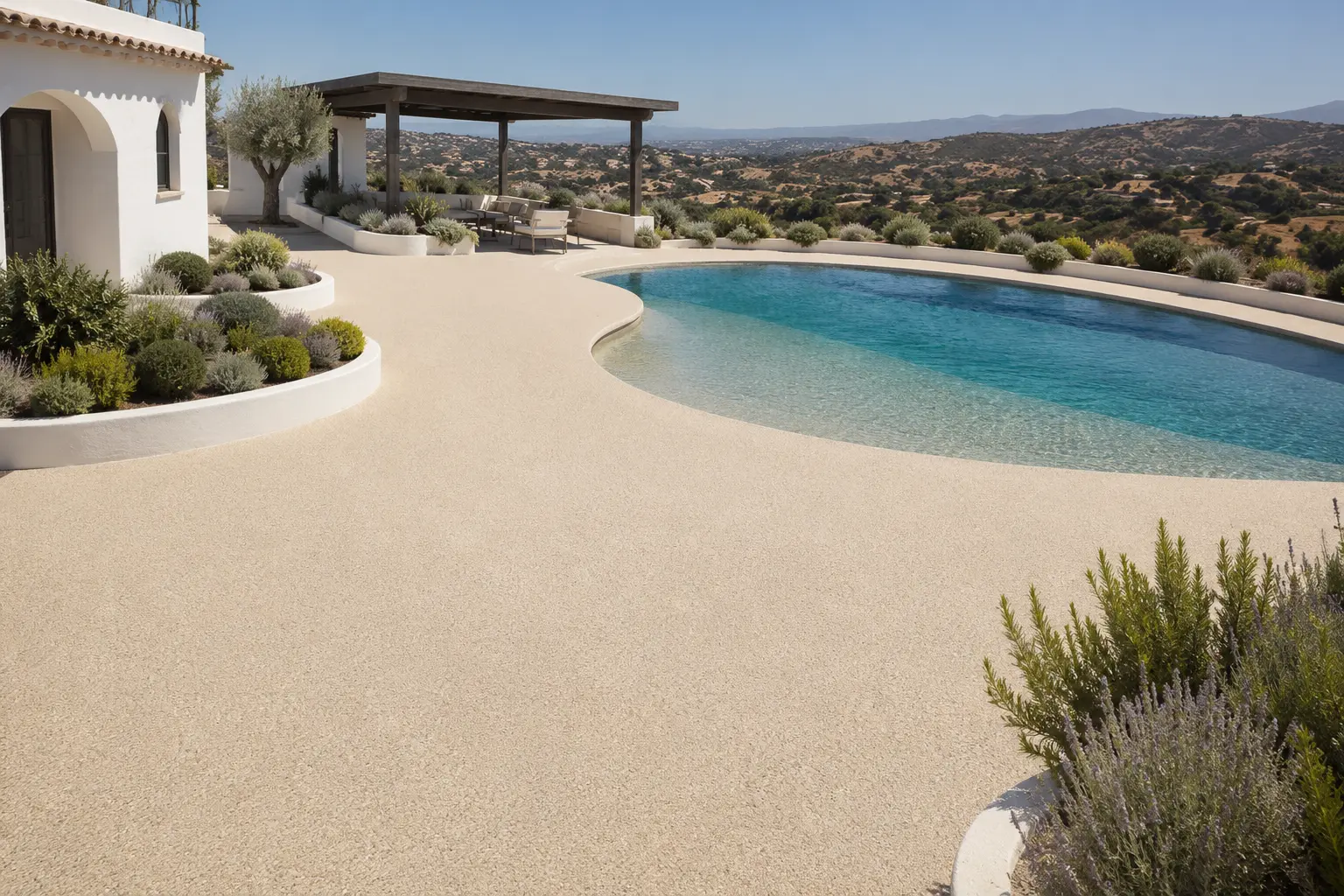
A continuous aggregate finish for private pools, residential communities, hotels and resorts, specified around the way the area will actually be used.
Wet-use grip, drainage, surface temperature, pool chemicals and the condition beneath the surface all need to be considered before installation.
Tell us about your pool area What to check before choosing a surfaceWhy resin-bound aggregate is considered around pools
Pool surrounds have to cope with bare feet, splashed water, cleaning, strong sunlight and frequent movement between wet and dry areas. Cracked tiles, loose joints and awkward repairs can also leave an older pool terrace looking divided even when the pool itself remains in good condition.
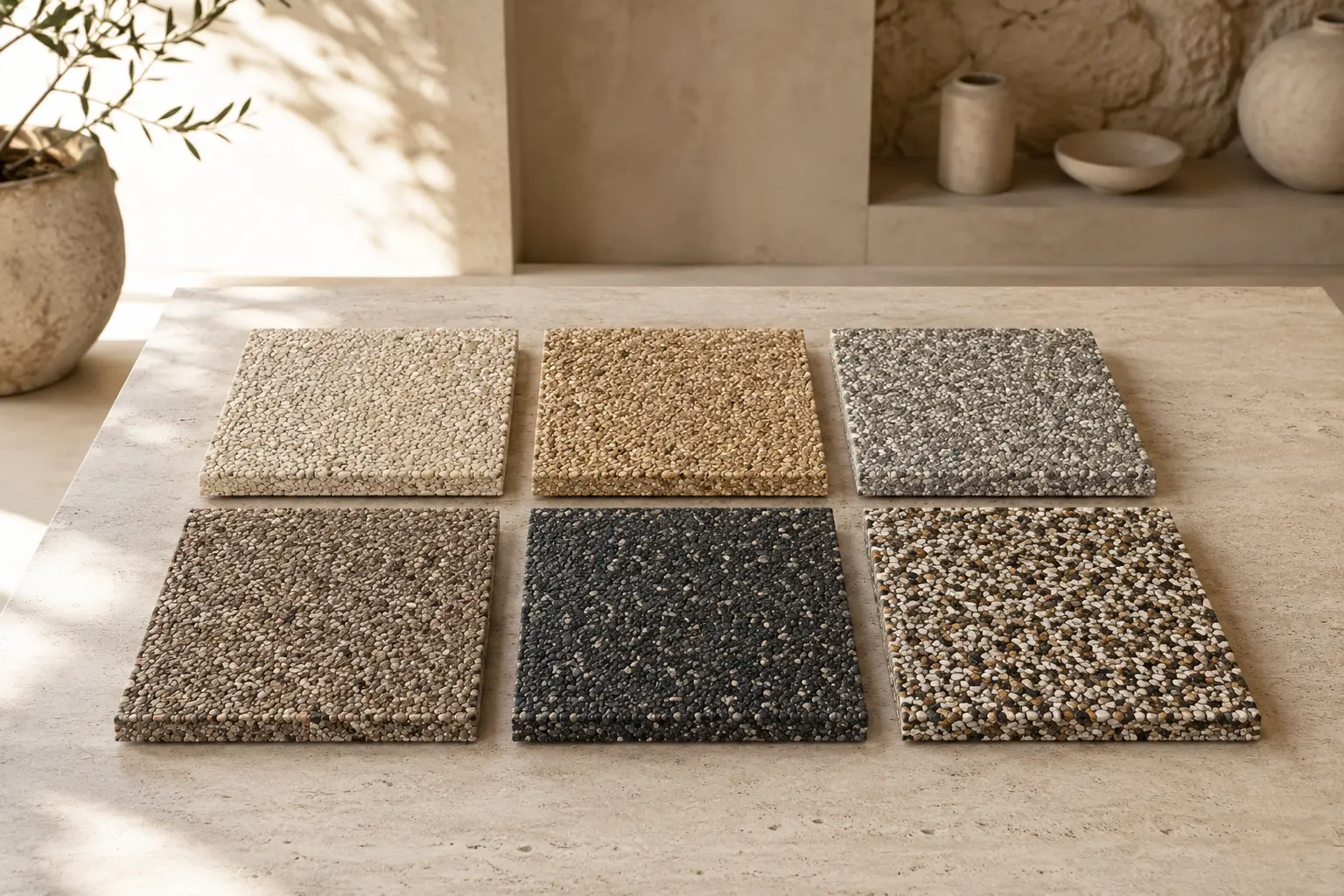
Resin-bound aggregate creates a continuous stone finish that can follow curves, steps and changes in level with fewer visible joints than conventional tiles. Colours and aggregate blends can be selected to work with the coping, property and surrounding landscaping.
Suitability still depends on the full proposal. The finished appearance cannot compensate for a moving base, poor drainage or a surface whose wet-use performance has not been established.
The five questions that matter most
1. How will grip be assessed?
“Non-slip” is not a useful specification on its own. Grip changes with the surface texture, aggregate, finishing method, contamination and whether the area is wet or dry.
For a hotel, community or other project within the scope of Spanish building requirements, the required floor classification and evidence should be checked for that location and use. The current Spanish CTE includes rules and supporting guidance concerning floor slip resistance. A resin-bound system should not be described as meeting a particular class unless the relevant finish has suitable test evidence.
Private pool owners should apply the same practical standard even where a particular commercial classification is not being requested: ask how the proposed finish has been assessed in wet conditions and whether any declared result relates to the actual aggregate and installation method.
Slip resistance and resin-bound flooring2. Where will the water drain?
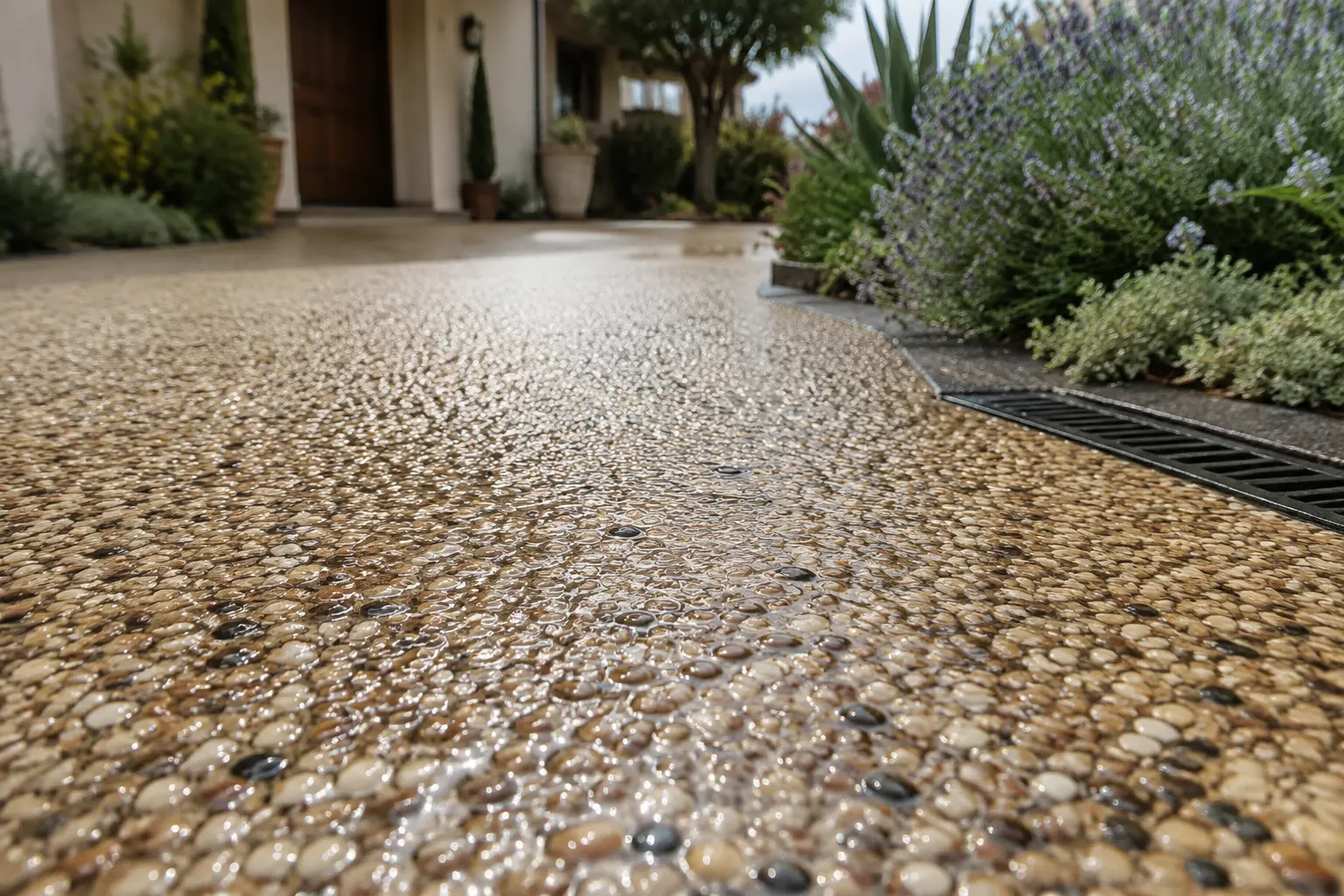
Resin-bound surfaces are often promoted as permeable. That description may apply to the upper layer, but water cannot disappear into an impermeable or saturated construction beneath it.
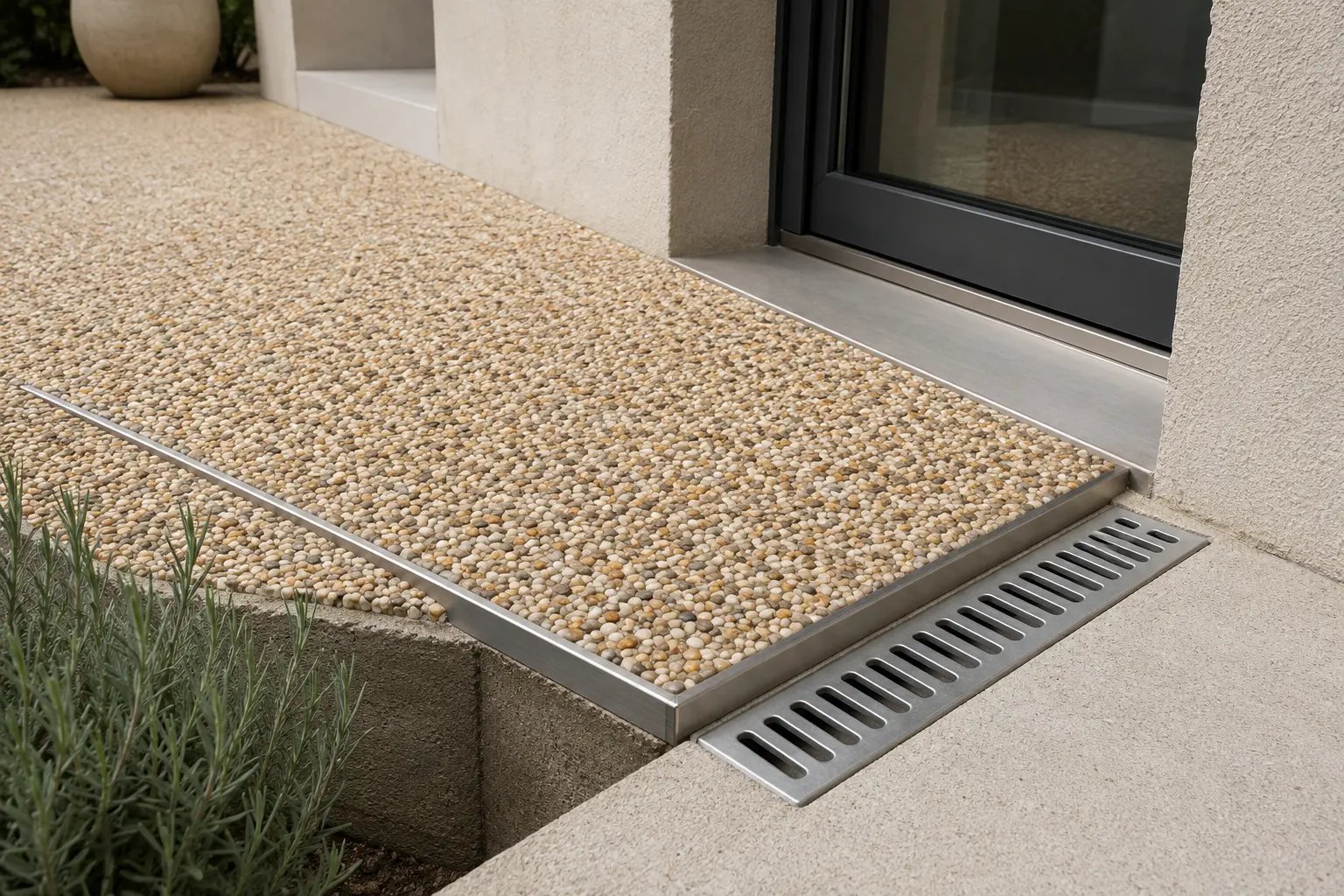
Some pool terraces are designed to drain through outlets and surface falls rather than through the full base. Others may use a permeable build-up. The correct arrangement depends on the existing construction, ground conditions, thresholds and the way water is already managed around the pool.
The proposal should identify whether the finished system is intended to be permeable or whether it will direct water across the surface. It should also explain how the coping, channels and adjoining areas are treated.
Drainage and permeability3. Is the existing pool terrace a suitable base?
Many Spanish pool areas are tiled. Resin-bound aggregate may be considered as an overlay where the tiles and construction beneath them are sound, stable and suitably prepared.
Loose or hollow tiles are not a secure base. Active cracks, movement, trapped moisture, failed joints and incorrect falls need to be investigated rather than hidden. In some cases local repairs and preparation may be sufficient. In others, the existing finish or more of the underlying construction will need to be removed.
Edges, drains, inspection covers, steps and door thresholds also affect the available installation depth. A site assessment should deal with these details before the new finished level is agreed.
Can resin-bound flooring be laid over outdoor tiles? Substrates and ground preparation4. How will the surface behave in strong sunlight?
Pool areas are often among the most exposed surfaces on a property. The binder must be suitable for exterior use and the colour choice should account for long periods of direct sun.
The proposed resin should be identified rather than described only as “UV resistant”. Ask what the manufacturer declares about exterior colour stability and whether that information applies to the product being quoted.
Aggregate colour also influences the appearance and comfort of a pool terrace. Very dark blends may absorb more heat, while extremely pale finishes can show dirt and organic staining more readily. Samples should be viewed outside under strong light where possible.
5. What will contact the surface?
Pool water is only one source of exposure. Chlorine or salt treatment, cleaning products, sunscreen, leaves, soil, food and drink can all reach the surrounding floor.
No general claim about resin-bound flooring can establish resistance to every chemical or cleaning method. Commercial buyers should request the maintenance guidance and available chemical-resistance information for the proposed system. Private owners should also know which cleaning products and pressure-washing methods are permitted.
Private, communal and hotel pools need different plans
Private pool surrounds
A private project may focus on covering an ageing tiled terrace, reducing visual joints and coordinating the pool area with paths or a patio. Access for materials, existing drainage and the available level beneath doors and coping remain important even on a smaller site.
Residential communities
A communal pool may need to remain accessible for part of the project, with works scheduled around the swimming season. The committee or administrator should obtain quotations based on the same area, preparation, system and edge details. Slip-resistance evidence and maintenance responsibilities should be included in the decision.
Resin-bound surfacing for residential communitiesHotels and resorts
Hotel pool areas combine continuous guest use with cleaning, furniture movement and narrow closure windows. The programme may need to divide a large area into sections or schedule work outside the main season. Return-to-service conditions and protection during other refurbishment work should be agreed in writing.
Resin-bound surfacing for hotels and resortsCoping, drains, steps and thresholds
Pool surrounds are full of small junctions that affect the finished result.
The new surface may meet coping stones, channel drains, planting areas, shower points, equipment covers, walls, steps and internal floor thresholds. Raising the level without resolving those junctions can reduce drainage capacity, obstruct access covers or create awkward edges.
The proposal should show where the resin-bound finish begins and ends, how it is restrained and what happens at each fixed feature. Curved pools and free-form terraces are possible applications, but they still need controlled edges and a consistent installation depth.
Repairing or resurfacing an existing pool area
Resurfacing can be attractive because it may reduce demolition and disruption. It is appropriate only where the retained construction is suitable.
If tiles have failed because the base is moving, an overlay is likely to inherit the problem. If water is trapped or moving through cracks, the source needs to be found. Localised damage may be repairable but the visual result and colour matching should be discussed before work begins.
Repairs and resurfacingCleaning and maintenance
Routine sweeping or removal of leaves and debris helps prevent organic material accumulating in the textured surface. Shaded, irrigated or heavily planted areas may need more frequent attention than open sunny terraces.
Cleaning methods should follow the guidance supplied for the installed system. Aggressive chemicals and uncontrolled pressure washing can damage some surfaces or disturb joints and edges. Spills and contaminants should be dealt with promptly using an appropriate method rather than left until the next general clean.
Maintaining resin-bound surfacesPool-surround costs in Spain
The size of the pool deck is only one part of the price. Access, curves, steps, drains, coping, existing tiles, substrate repairs and the number of fixed details can make two areas of the same size very different jobs.
A quotation should separate preparation and corrective work from the resin-bound installation where possible. This makes it easier to see whether a lower price assumes that the existing surface can simply be covered.
Resin-bound flooring costs in SpainTell us about your pool area
Provide the property location, pool type, approximate surface area and current finish. Include known drainage or tile problems and add photographs where useful.
The information will be reviewed before the appropriate next step is confirmed. Installation availability is not guaranteed in every part of Spain.
Submit your pool projectRelated information
- Commercial resin-bound surfacing
- Surfacing for hotels and resorts
- Surfacing for residential communities
- Can resin-bound flooring be laid over tiles?
- Slip resistance
- Drainage and permeability
- UV-stable resin
- Maintenance
- Costs in Spain