These answers cover the practical questions people ask before choosing resin-bound surfacing for a driveway, terrace, pool surround or commercial area in Spain.
They are deliberately concise. The linked technical and application pages explain the underlying decisions in greater detail. Product-specific figures, legal requirements and guarantees must be checked for the actual system and project.
Have a question about a particular site? Send the location, intended use, approximate area and photographs of the existing surface, thresholds and drainage.
Ask about your projectUnderstanding the material
What is resin-bound flooring?
Resin-bound flooring is made by mixing clean, dry graded aggregate with a liquid resin binder before the material is spread and hand finished over a prepared base. The resin coats the aggregate and binds it into a fixed decorative surface.
Many exterior systems retain connected voids that allow water through the finish. The complete installation is only fully permeable when the base and drainage design allow that water to continue to a suitable destination.
Read the full explanation of resin-bound flooringIs stone carpet the same as resin-bound flooring?
The terms overlap, but their use varies between countries and suppliers. “Stone carpet” often describes a decorative resin-and-aggregate finish and may include interior systems with filled pores. “Resin-bound” usually describes the method of mixing aggregate and binder before application.
The name does not establish the resin chemistry, aggregate grading, permeability, surface depth or intended use. Those details belong in the specification.
What is the difference between resin-bound and resin-bonded surfacing?
In a resin-bound system, aggregate is mixed through the resin before laying. In a resin-bonded system, resin is applied to a base and loose aggregate is scattered onto it.
The resulting textures and drainage characteristics differ. Resin bonded is generally rougher and is not treated as a porous full-depth system. The two names should not be used interchangeably in a quotation.
Is resin-bound flooring suitable outdoors in Spain?
It can be suitable when the binder, aggregate, base, drainage and installation method are specified for exterior use and the particular site.
Spanish conditions make UV stability and installation temperature important. Pool water, irrigation, dust and intense exposure may also affect colour choice and maintenance. Suitability is a system decision rather than a property of the name “resin-bound”.
Understand UV-stable exterior resinCan resin-bound flooring be used indoors?
Interior stone-carpet systems exist, but they may be designed differently from porous exterior paving. Pore filling, hygiene, cleaning, acoustic behaviour, fire performance and compatibility with the base can become relevant.
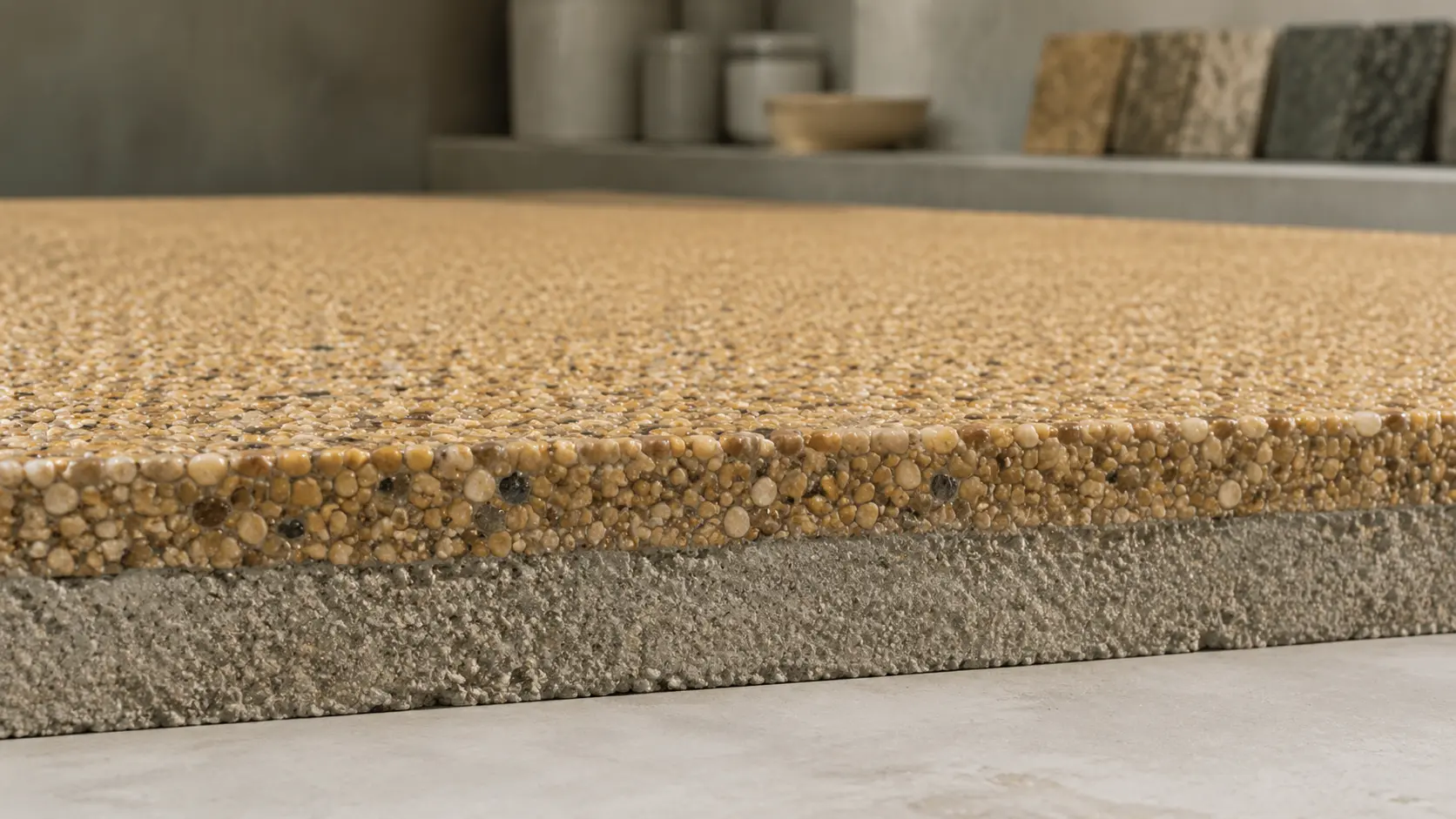
Stone Carpet Spain's initial authority content focuses on exterior applications. An interior proposal should use documentation for the intended indoor system rather than repurpose an exterior specification.
Existing surfaces and preparation
Can resin-bound flooring be laid over concrete?
Sound, stable concrete can be a suitable base after proper assessment and preparation. Cracks, movement joints, laitance, paint, sealers, oil, moisture and weak repairs need attention.
Conventional concrete is impermeable. Water passing through a porous resin-bound finish must therefore follow the slab's falls towards a suitable outlet.
See the concrete and substrate requirementsCan it be laid over outdoor tiles?
Sometimes, but tiles are not automatically suitable. Loose, hollow or moving units, trapped moisture, failed beds, wide joints and insufficient threshold height can make removal the better option.
An overlay proposal should explain how the tiled construction was assessed and how levels, drainage and edges will work after the finished surface is raised.
Can it be laid over asphalt?
Stable asphalt may provide a suitable substrate. Soft areas, wheel-path deformation, fuel contamination, repaired trenches and failed edges must be investigated first.
Dense asphalt generally acts as an impermeable layer. Open-textured asphalt may form part of a permeable construction when designed for that purpose. Appearance alone does not prove which construction is present.
Can it cover cracked concrete?
A crack should be diagnosed rather than simply hidden. A static shrinkage crack and an actively moving slab need different treatment. Movement may reflect through a new decorative layer if its cause remains.
Where structural movement is suspected, an appropriate construction professional should assess it. Resin-bound surfacing is not a structural repair.
Can an old resin-bound surface be overlaid?
An overlay may be possible if the existing surface remains firmly bonded and the underlying construction is stable. Loose aggregate, soft areas, detachment, cracking and drainage problems need diagnosis.
The additional height affects thresholds, edges and covers. A new layer should not be used to conceal unexplained failure.
Is excavation always necessary?
No. A suitable existing base may allow an overlay with preparation and local repairs. Excavation becomes more likely where the existing build-up is unstable, levels do not work, drainage needs reconstruction or the intended loads exceed the base's capacity.
The survey should determine what can remain rather than assume either complete removal or automatic overlay.
Drainage and permeability
Is resin-bound flooring permeable?
Many resin-bound finishes are porous because small connected voids remain between coated aggregate particles. Water can move through the decorative layer.
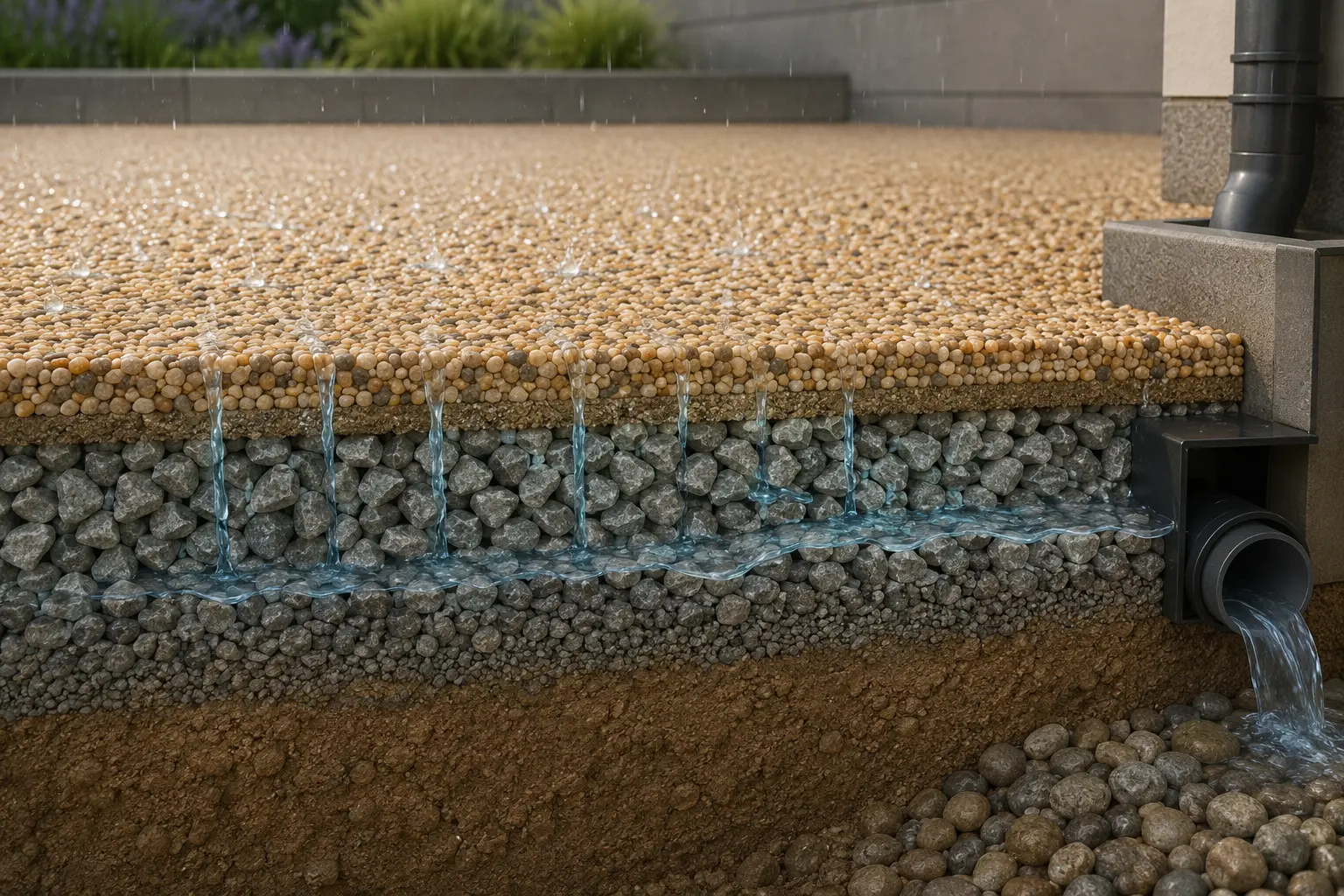
That does not prove that the complete pavement is permeable. A full permeable build-up needs suitable open base layers and ground or drainage capable of receiving the flow.
Read about drainage and full-system permeabilityWhat happens when resin-bound flooring is laid over concrete?
Water can enter the porous finish and then meet the solid slab. It needs a route along the concrete's fall towards a channel, outlet or open edge.
Flat slabs, low points and raised perimeter details can trap water beneath or within the surface. The drainage route must be resolved before installation.
Does a permeable surface eliminate drainage channels?
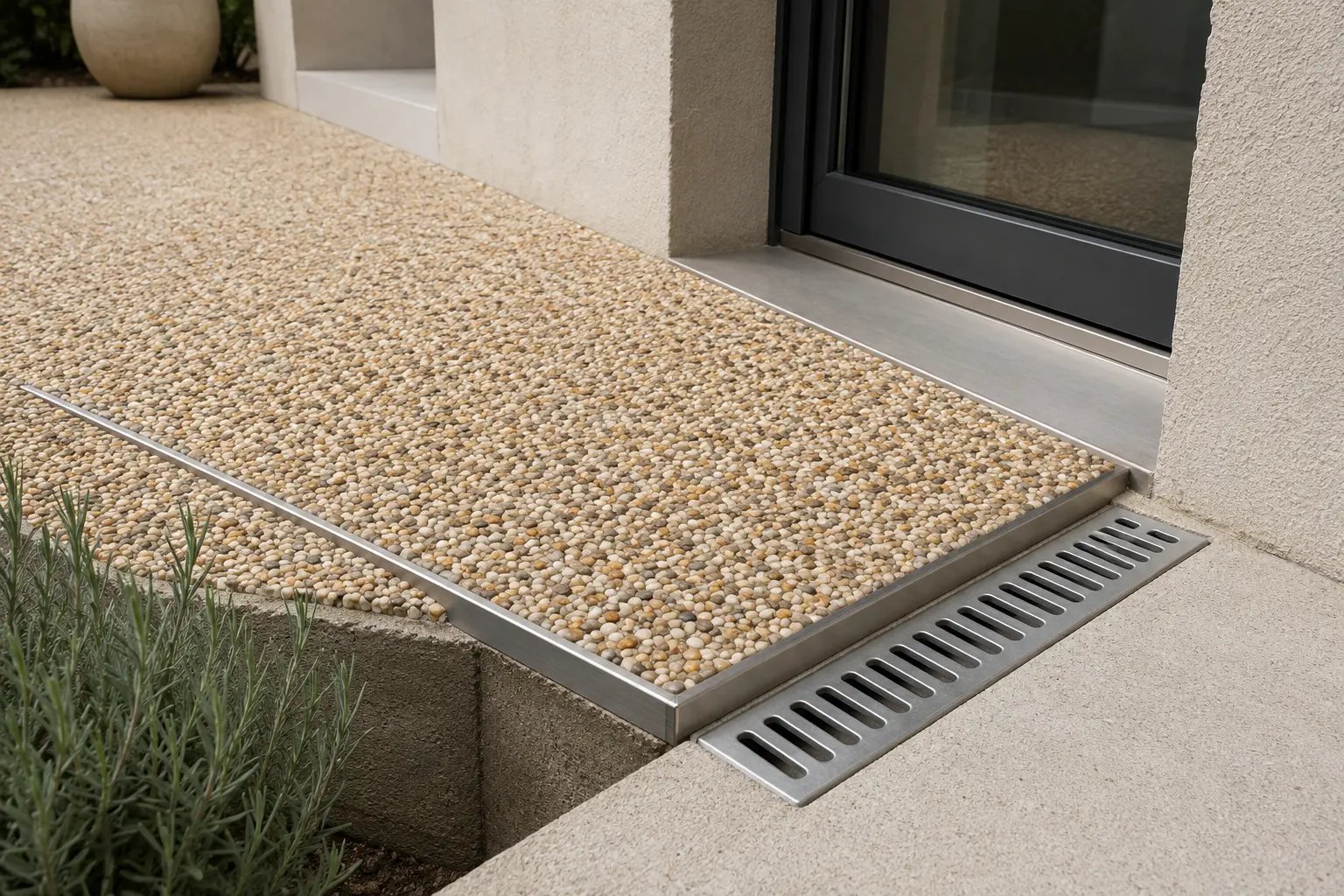
Not necessarily. Channels may still be needed where the base is impermeable, runoff arrives from roofs or higher paving, the ground drains slowly or an overflow route is required.
The full catchment area matters. A small resin-bound terrace can receive a large amount of water from a roof or neighbouring surface.
Will resin-bound flooring stop puddles?
A correctly designed porous finish can reduce surface water, but no universal no-puddle promise is responsible. Blocked voids, poor falls, low spots, inadequate outlets and unsuitable ground can still create standing water.
Persistent puddling should be investigated rather than accepted as a cleaning issue alone.
Can it waterproof a balcony or roof terrace?
No assumption should be made that a porous decorative layer replaces waterproofing. The building's waterproof membrane, falls and outlets remain the primary protection.
A balcony or roof-terrace proposal should be coordinated with the existing waterproofing, structural loading, threshold clearances and drainage design.
Cost and quotation questions
How much does resin-bound flooring cost in Spain?
There is no reliable national square-metre rate for every project. The cost changes with the existing base, preparation, drainage, access, project size, edges, steps, selected materials and intended use.
Current Spanish online offers are too sparse and inconsistent to establish a defensible market average. A scope-led quotation is more useful than an attractive starting figure with unclear exclusions.
See the complete resin-bound cost breakdownWhy do small areas cost more per square metre?
Delivery, site setup, mixing equipment, labour and clean-down are required even for a small area. Those fixed costs are spread across fewer square metres.
Small pool surrounds and terraces can also contain more curves, steps, covers and edge detail than a large open driveway.
Is laying over an existing surface always cheaper?
Only when that surface is suitable. A straightforward overlay can avoid excavation and new base construction. Covering loose tiles, active cracks or failed drainage transfers risk into the new finish and may cost more to correct later.
The quotation should explain how the base was assessed and which preparation is included.
What should a quotation include?
It should identify the measured area, existing substrate, preparation, repairs, base work, drainage, edges, steps, resin system, aggregate blend, access arrangements and intended use.
It should also state exclusions, weather dependencies, payment stages, IVA treatment and any guarantee terms. A finish-only proposal should be labelled as such.
Can I get a firm price from photographs?
Photographs can support an initial estimate and identify visible constraints. They cannot confirm that tiles are bonded, a slab is stable or hidden drainage is adequate.
A firm quotation may require a site visit, measurements and further substrate or moisture investigation. Any photograph-based figure should list its assumptions.
Installation questions
How is resin-bound flooring installed?
The project begins with a survey, substrate and drainage assessment and written specification. The base is then repaired or constructed, cleaned and prepared.
On the surfacing day, resin components and dry aggregate are mixed consistently, transferred to the area, spread and hand finished. The surface is protected until the specified system has cured under the actual conditions.
See the complete installation processHow long does installation take?
The surfacing phase may be short on a simple prepared base, but that is not the same as the whole project duration. Excavation, new structural layers, drainage work, repairs, restricted access and weather can extend the programme.
Ask the quotation to separate working days from elapsed calendar time and to state any waiting periods or conditions.
How long before the surface can be walked or driven on?
There is no safe universal opening time. Resin formulation, catalyst, material temperature, air conditions and intended load affect curing.
The installer should provide the release time for the named system under the conditions experienced. Pedestrian access and vehicle access may have different restrictions.
Can it be installed in hot weather?
Only within the specified product limits. Direct sun can make concrete and asphalt considerably hotter than the surrounding air, shortening working time and increasing the difficulty of consistent finishing.
Air temperature, surface temperature, humidity, dew point and weather risk should be checked. Calling a resin UV stable does not mean it can be installed at any temperature.
Can it be installed if rain is forecast?
Moisture can interfere with resin-bound mixing, application and curing. Dry aggregate and suitable base conditions are important.
The decision must follow the selected system's current instructions and the forecast. A completed porous surface being designed to pass rainwater does not make wet installation conditions acceptable.
Will there be visible joints?
The team normally works to maintain a live edge between batches. Existing movement joints may still need to be carried through the finish and planned stopping points or colour changes can remain visible.
An unexpected interruption may create a day joint. The proposed joint layout should be discussed on larger or divided sites.
Colour and appearance
Will resin-bound flooring fade in the Spanish sun?
A documented aliphatic UV-stable binder is designed to resist UV-related yellowing or darkening. Non-UV-stable aromatic resin can change colour, particularly where covered and exposed areas receive different sunlight.
Natural aggregate can still weather or lighten. Dirt, mineral staining, wear and cleaning also affect appearance. “UV stable” applies to the stated binder property rather than every possible visual change.
Read about UV stability and colour changeWhy does the cured sample look darker than loose stone?
Clear resin coats the aggregate and deepens its colour, often making it look closer to wet stone. A loose handful is therefore a poor representation of the finished surface.
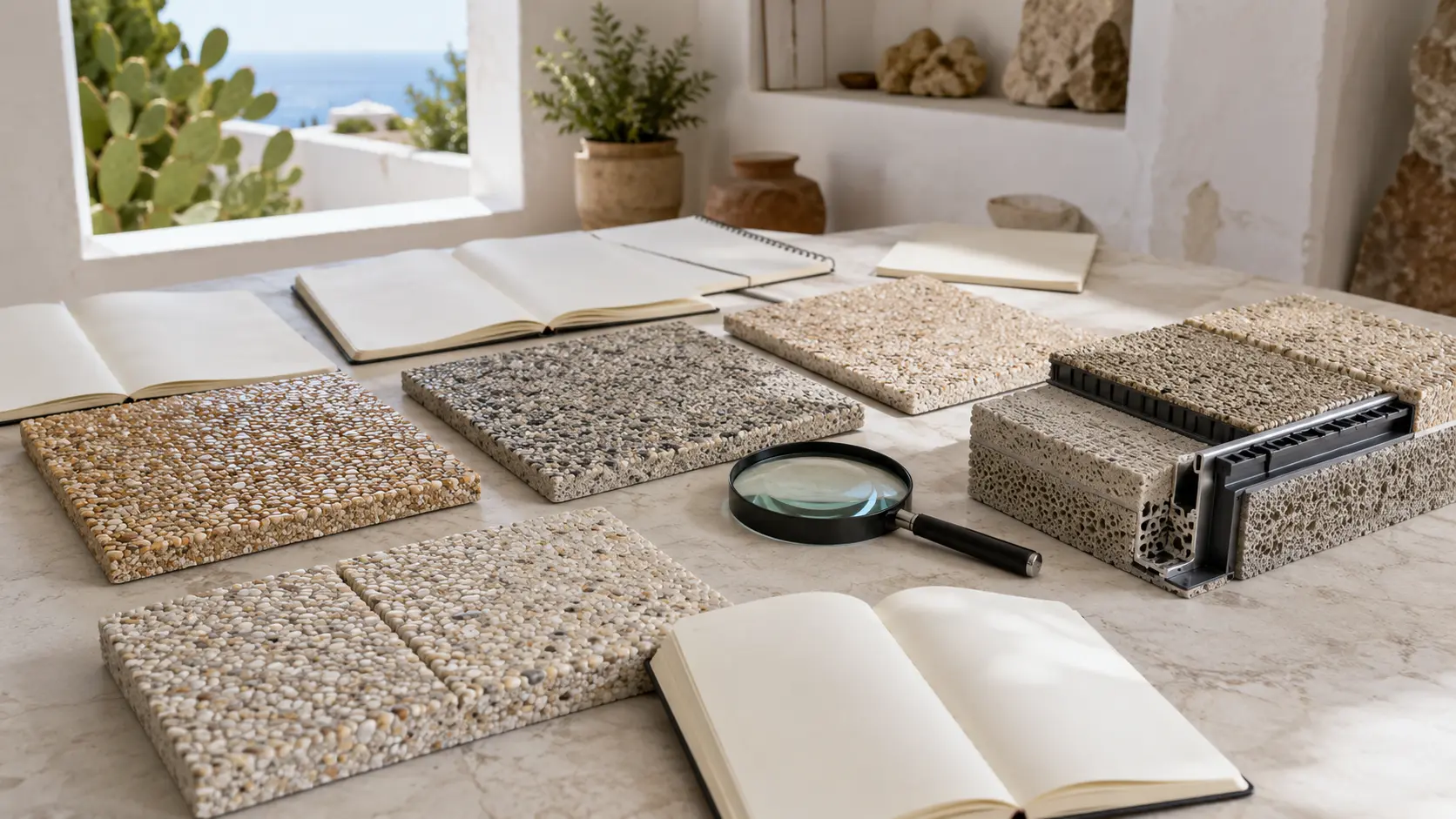
Approve a cured sample made with the specified resin and complete blend. View it outdoors in sun and shade beside adjoining materials.
Can a damaged patch be repaired invisibly?
Local repair may be possible, but an invisible match should not be promised. Original stone availability, quarry and batch variation, weathering, dirt, resin age and finishing texture can all reveal the repair.
A repair placed at a natural boundary or across a defined section may look more deliberate where appearance is especially important.
Are pale colours suitable for driveways and pool surrounds?
They can be, with realistic expectations. Pale blends may feel visually lighter around pools and suit rendered properties, but they can show tyre marks, soil, leaves and mineral residues more readily.
The use, exposure and cleaning regime should influence the choice. A mixed neutral blend may disguise ordinary variation better than a near-white monochrome finish.
Slip resistance and safety
Is resin-bound flooring non-slip?
No surface should be called slip-proof. Resin-bound systems can provide tested slip resistance, often using the aggregate texture and a specified additional surface treatment.
The result changes with water, slope, contamination, wear and maintenance. Ask for evidence tied to the exact product, test method and wet or dry condition.
Understand slip resistance and Spanish requirementsIs it suitable around swimming pools?
It can be suitable when the named system has appropriate wet-area evidence and the complete design addresses falls, drainage, copings, channels, barefoot comfort and maintenance.
Spanish building requirements may apply depending on the pool and building use. Hotels, communities, commercial leisure facilities and private homes should not be assumed to share an identical compliance position.
What does Class 3 slip resistance mean in Spain?
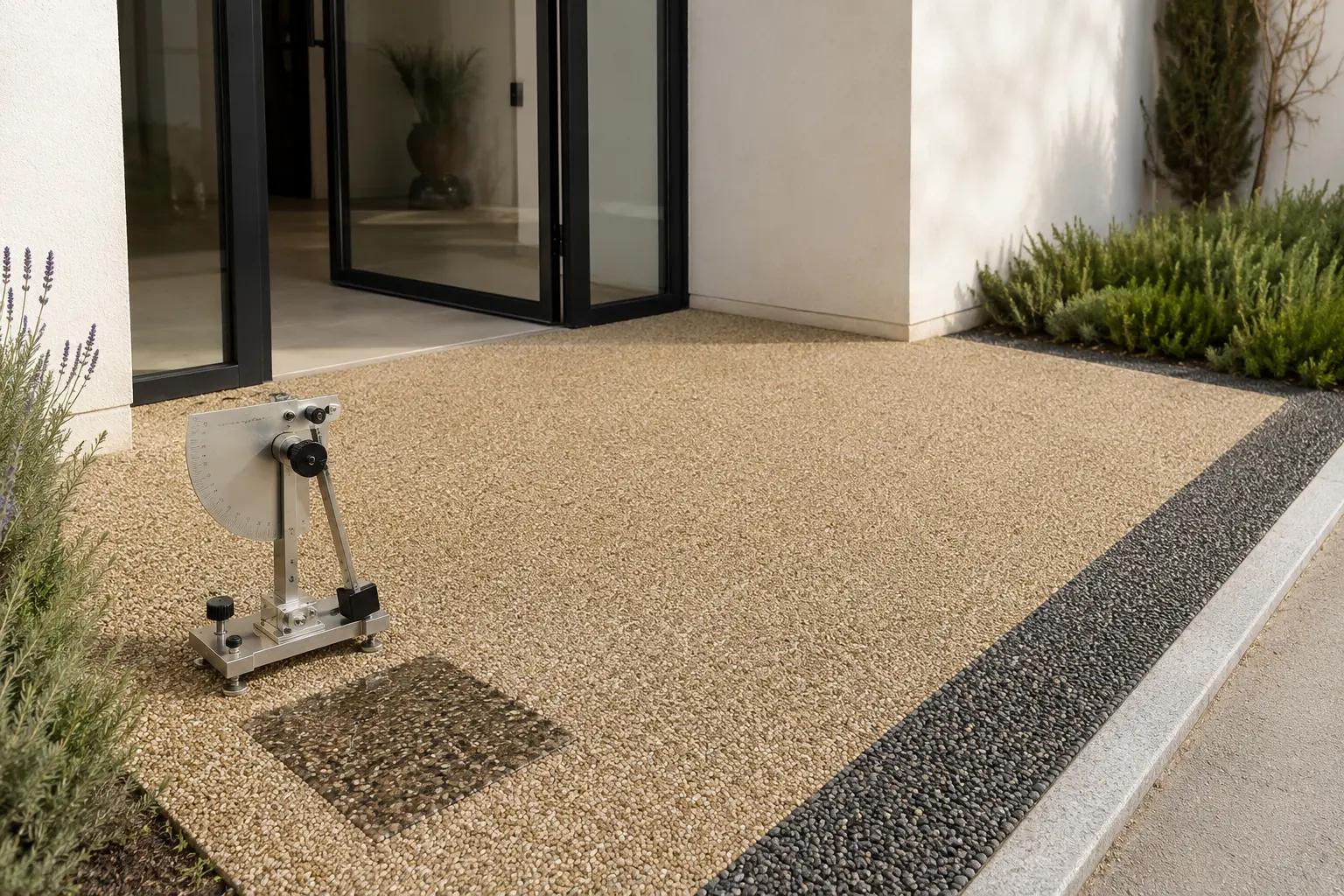
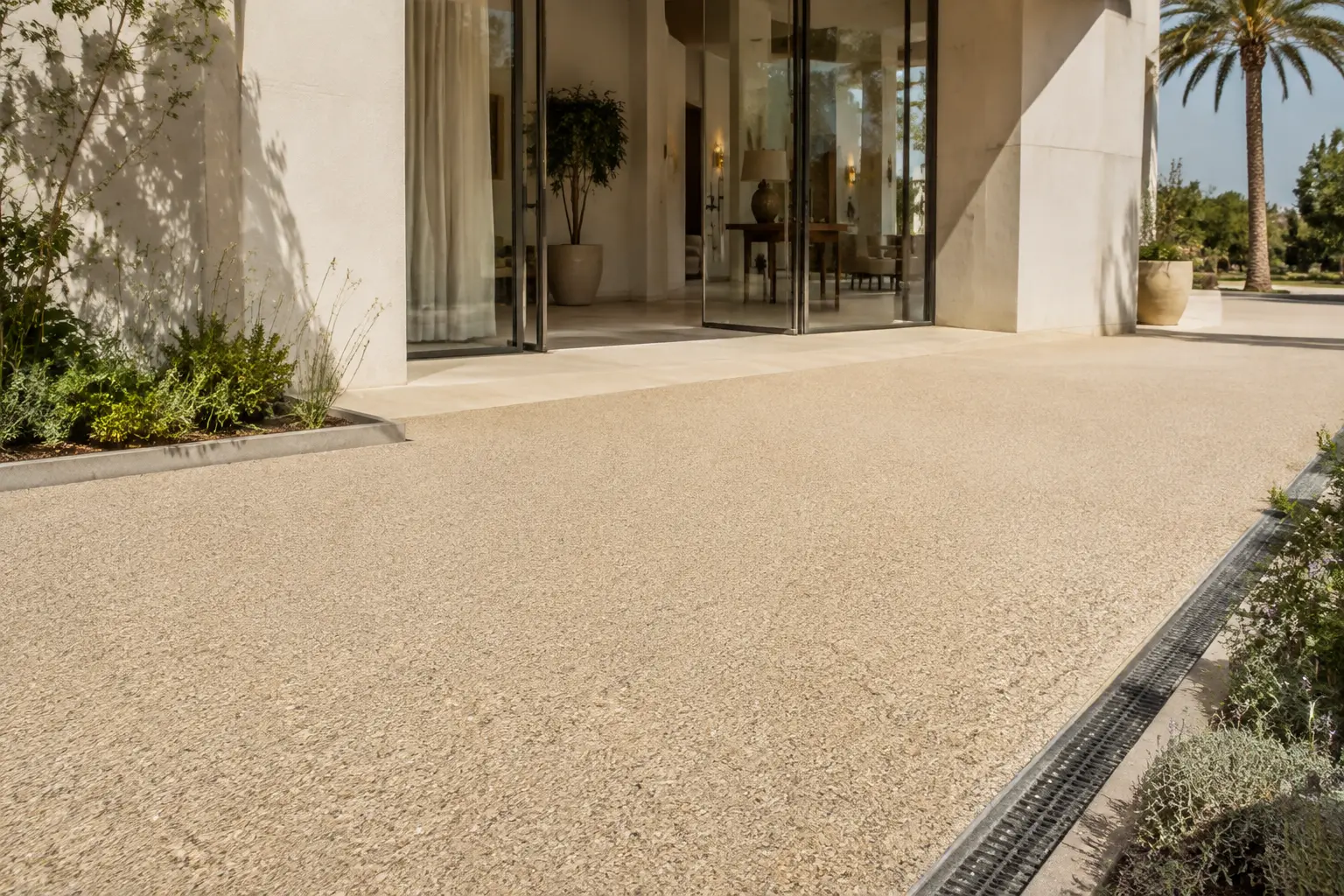
Within the applicable scope of Spain's CTE DB-SUA, floors are classified by an Rd value from the stated wet pendulum test. Class 3 means Rd greater than 45. The document identifies exterior areas, qualifying pool areas and showers as requiring Class 3 for the uses covered by that section.
The class should not be assigned to an unspecified resin surface. A competent project professional should determine applicability and acceptable evidence.
Does permeability make a surface safe when wet?
Permeability can help reduce standing water when the full drainage system works. It is not a slip-resistance test or guarantee.
Splashing, contaminants, slopes and exceptional flows can still create risk. Surface performance and drainage need to be assessed together.
Maintenance and durability
Is resin-bound flooring maintenance-free?
No. Routine sweeping and compatible periodic cleaning help remove soil, leaves and fine material. Channels and outlets need to remain clear.
Oil, sunscreen, food grease, irrigation deposits and organic growth should be addressed using guidance for the selected system. Neglect can affect appearance, drainage and slip resistance.
Can weeds grow through it?
A correctly constructed bound surface reduces open joints where weeds commonly establish, but no absolute weed-free promise is sensible. Wind-blown seeds can root in accumulated dirt and organic material on top. Growth may also exploit cracks, failed edges or disturbed areas.
Regular cleaning and prompt repair of defects are more credible than relying on the resin alone.
Can it be pressure washed?
Many manufacturers permit controlled pressure washing under their maintenance instructions. Excessive pressure, a nozzle held too close or aggressive work at edges and repairs can damage the surface.
Follow the named system's guidance and ensure dirty water and detergent residues are removed through a suitable drainage route.
How long does resin-bound flooring last?
Service life depends on the proprietary system, base, loading, installation, exposure and maintenance. Manufacturer statements and guarantees apply only under their stated terms.
A universal lifespan claim for an unspecified surface is not reliable. Ask who provides the guarantee, what it covers and whether workmanship, base failure, aggregate change and maintenance are excluded.
Can the surface be resealed or rejuvenated?
Some manufacturers offer compatible treatments for their systems. These may alter colour depth, gloss, permeability and slip behaviour.
The cause of any deterioration should be diagnosed first. A generic clear coating should not be applied without confirming compatibility and the consequences for wet-area performance.
Applications and project suitability
Is resin-bound surfacing suitable for driveways?
It can be used for driveways when the base, surface specification, edges and drainage are designed for vehicle traffic. Turning, braking and occasional heavier access need to be included in the brief.
Increasing only the decorative layer does not correct an inadequate structural base.
Explore resin-bound drivewaysIs it suitable for terraces and patios?
Yes, subject to the base, levels and water route. Existing tiles, door thresholds, irrigation, shaded damp edges and transitions to the house deserve particular attention.
The finish can create a continuous-looking area around curves and fixed features, but joints required by the base still need proper detailing.
Explore terraces and patiosCan it be used for commercial surfacing?
Proprietary systems can serve commercial pedestrian and vehicle applications when selected and documented for the expected use. Footfall, deliveries, cleaning, accessibility, phased working and regulatory evidence become part of the specification.
A domestic product description should not be treated as proof for a hotel, restaurant, shop or public route.
Plan commercial resin-bound surfacingDo I need permission for resin-bound surfacing in Spain?
The answer depends on the municipality, property, type of work and location. Altering a vehicle access, shared community area, drainage route, protected building or public interface may require approval.
UK statements about permeable driveways and planning permission do not establish Spanish law. Check with the relevant ayuntamiento, community administrator or project professional where the position is uncertain.
What information should I send with an enquiry?
Provide the town or province, approximate dimensions, intended use and current surface. Add photographs of the whole area and close views of cracks, drains, thresholds, steps and edges.
Mention vehicle access, standing water, restricted delivery routes and preferred timing. This supports an initial scope, although a site assessment may still be needed before a firm quotation.
Ask a project-specific question
The quickest route to a useful answer is to describe the site rather than ask for a product in isolation. The base, water route and use determine which resin-bound specification is credible.
Send the location, measurements and photographs. We can identify the points that need confirmation and direct the enquiry to the relevant next step.
Ask about your project