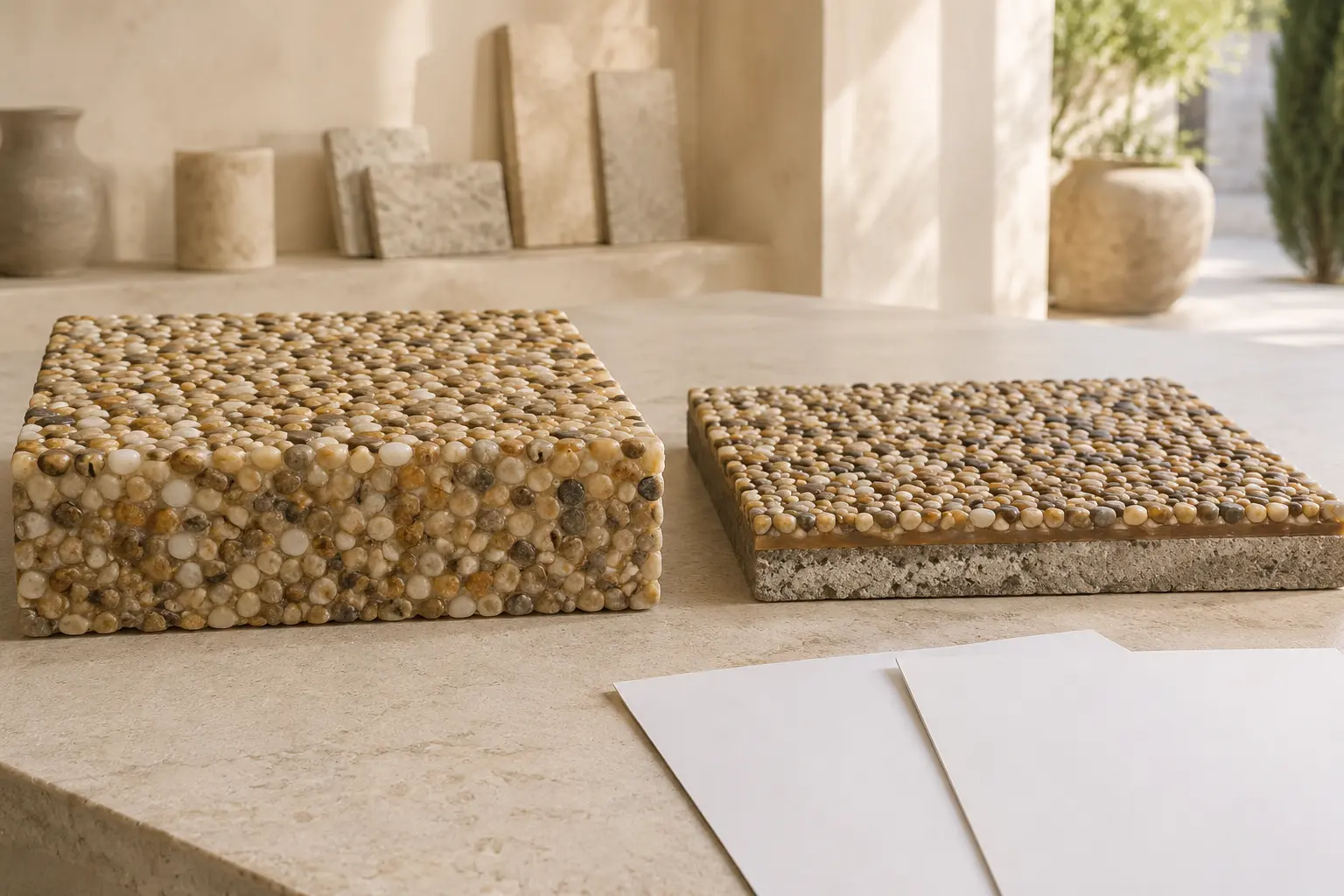
Resin-bound and resin-bonded surfacing are different systems. The names are separated by two letters but the installation method, finished texture and drainage behaviour are not the same.
In resin-bound surfacing, clean dry aggregate is mixed with resin before the material is laid and trowelled as a continuous layer. In resin-bonded surfacing, resin is applied to an existing base and dry aggregate is scattered over the wet coating. Excess stone is removed after cure.
If a Spanish quotation says only “resin and stone”, “stone carpet” or pavimento de resina, ask which method is being supplied. The answer should appear in the written specification, together with the exact product, base, aggregate and installed depth.
Neither method should be judged from the name alone. Resin-bound is usually the relevant system for the continuous, comparatively smooth decorative surfaces discussed throughout Stone Carpet Spain. Resin-bonded has legitimate uses where a thin, highly textured scatter finish is wanted over a suitable solid base. They should not be priced or described as though they were interchangeable.
The quickest way to remember the difference
Resin-bound: mixed first
The aggregate and liquid binder are measured and mixed so the stone particles are coated. The mixed material is placed over the prepared base, levelled and hand finished to the system's specified depth.
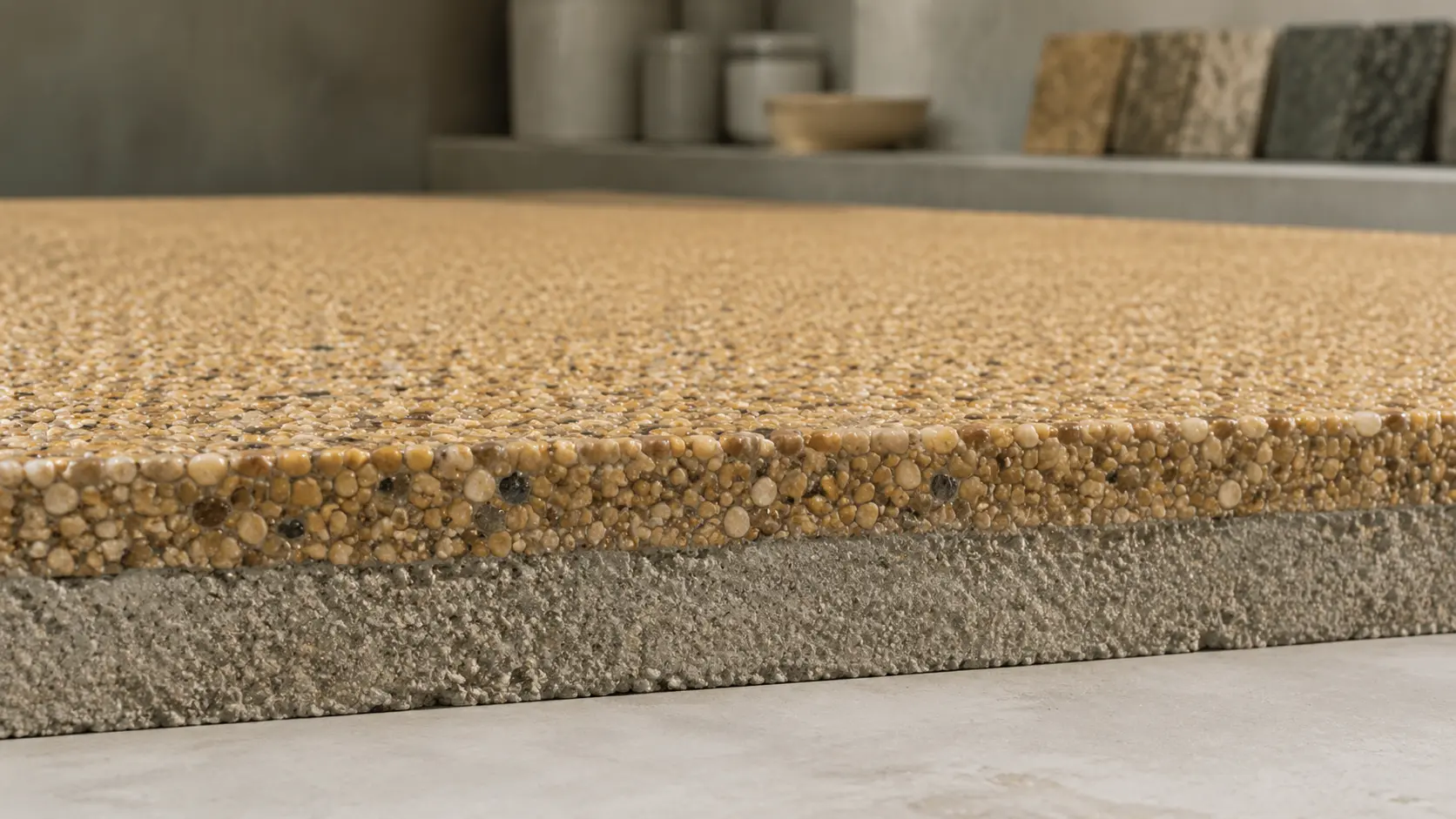
The finished layer contains bound aggregate throughout its thickness. Its surface is textured by the exposed profile of the coated stone, while small connected voids can allow water to pass through a correctly designed system.
Resin-bonded: resin first
A coating of resin is spread over the prepared base. Dry aggregate is then broadcast onto the wet resin. Stone in contact with the resin adheres as the coating cures, while unbonded excess is swept or vacuumed away.
This creates a coarse, loose-gravel appearance in a comparatively thin surface treatment. The stone is fixed at its underside rather than coated and held through a complete mixed layer.
A side-by-side comparison
| Question | Resin-bound | Resin-bonded |
|---|---|---|
| How is the stone used? | Mixed with resin before laying | Scattered over resin already spread on the base |
| How is it finished? | Trowelled as a continuous aggregate layer | Broadcast and left as an exposed stone texture |
| Where is the aggregate held? | Through the depth of the mixed layer | At the interface with the resin coating |
| Typical visual character | Even, continuous and comparatively smooth | Coarser loose-gravel appearance |
| Loose aggregate after completion | A correctly installed system should not have a layer of loose stone | Excess must be removed and some shedding can occur in use |
| Can the surface layer pass water? | Yes, when the selected blend and system contain connected voids | Generally treated as non-permeable and laid to surface drainage |
| Does that make the complete pavement permeable? | Only when every supporting layer and the water destination are designed for it | No |
| Is one automatically better? | No. It depends on the intended use and specification | No. It serves a different surface-treatment purpose |
The table describes the broad system types. Exact performance, depth, loading, slip resistance and chemical resistance come from the named product and complete build-up.
Why the names are confused
The terms sound alike and are often shortened to “resin surface”. Spanish suppliers and contractors may also use resina con árido, pavimento de resina y piedra, moqueta de piedra, alfombra de piedra or a proprietary product name.
Those descriptions do not always state the method. Stone carpet is especially broad. It can refer to an exterior polyurethane-bound aggregate system, a smaller-stone interior finish or a sealed decorative floor. The quotation must identify the actual construction.
Some websites use “resin bonded” as a loose description for any stone held by resin. That may be ordinary language but it causes problems in a contract. The installer should state whether the aggregate is mixed through the binder or broadcast onto a coating.
An image can also mislead. A finished bonded surface may resemble loose gravel, while a coarse bound blend can look heavily textured from a distance. Ask how it is made rather than identifying it from a photograph.
How resin-bound surfacing is installed
The base is assessed, prepared and accepted for the selected system. Edges, channels, joints and covers are completed to the required level before the decorative course is mixed.
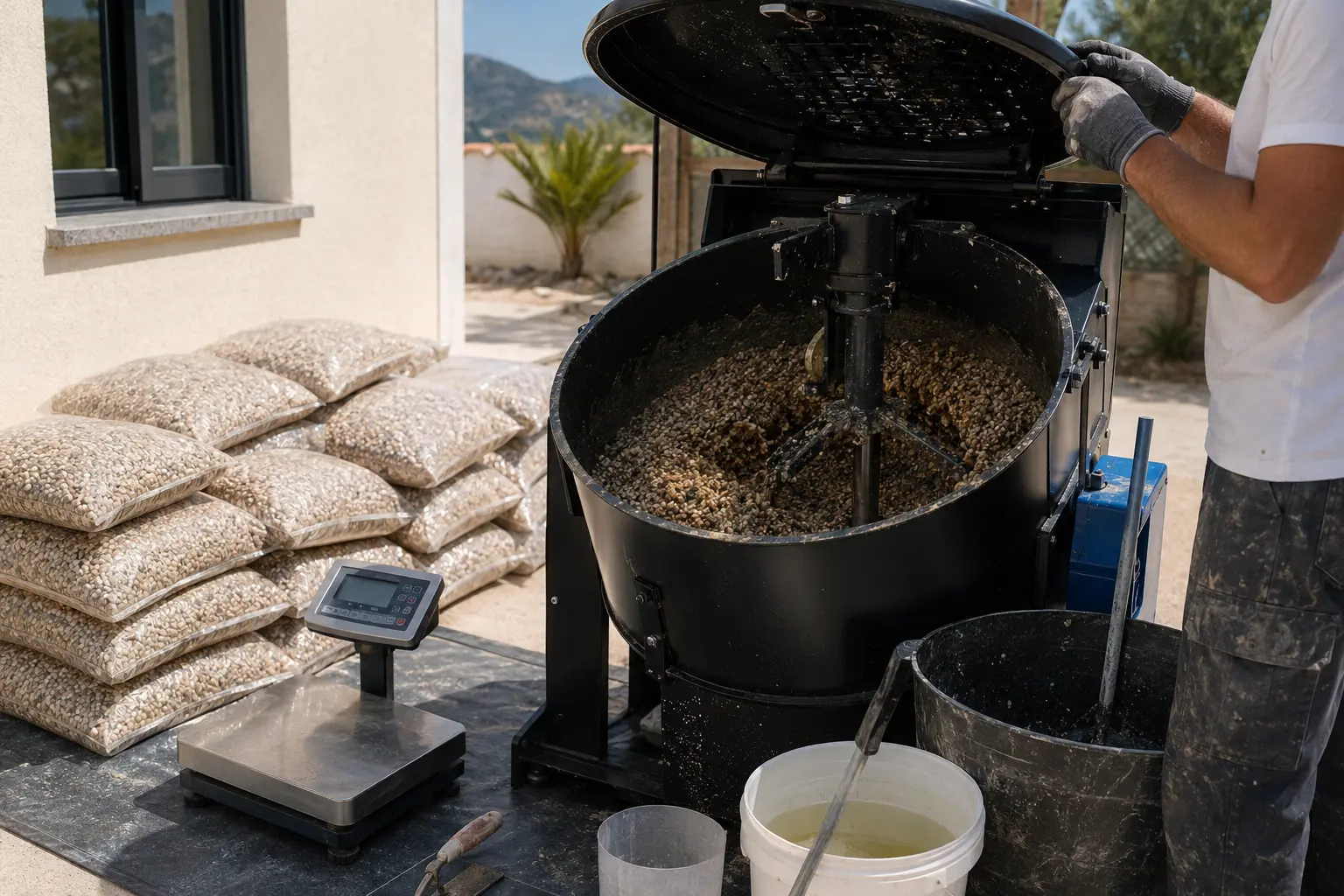
Measured aggregate and binder components are combined using equipment and a sequence suited to the system. Consistent batches matter because changes in aggregate weight, binder quantity or mixing time can alter appearance and performance.
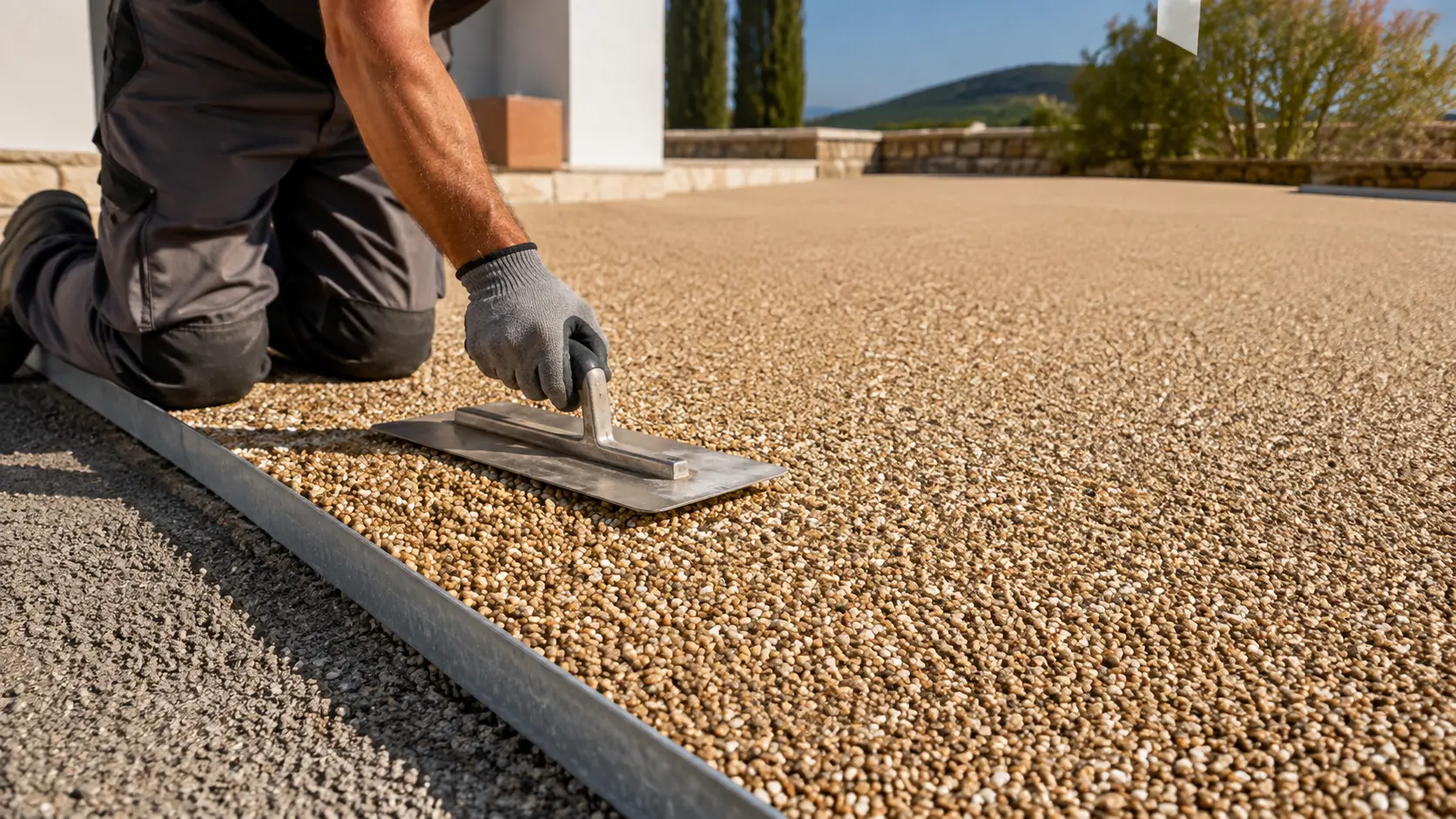
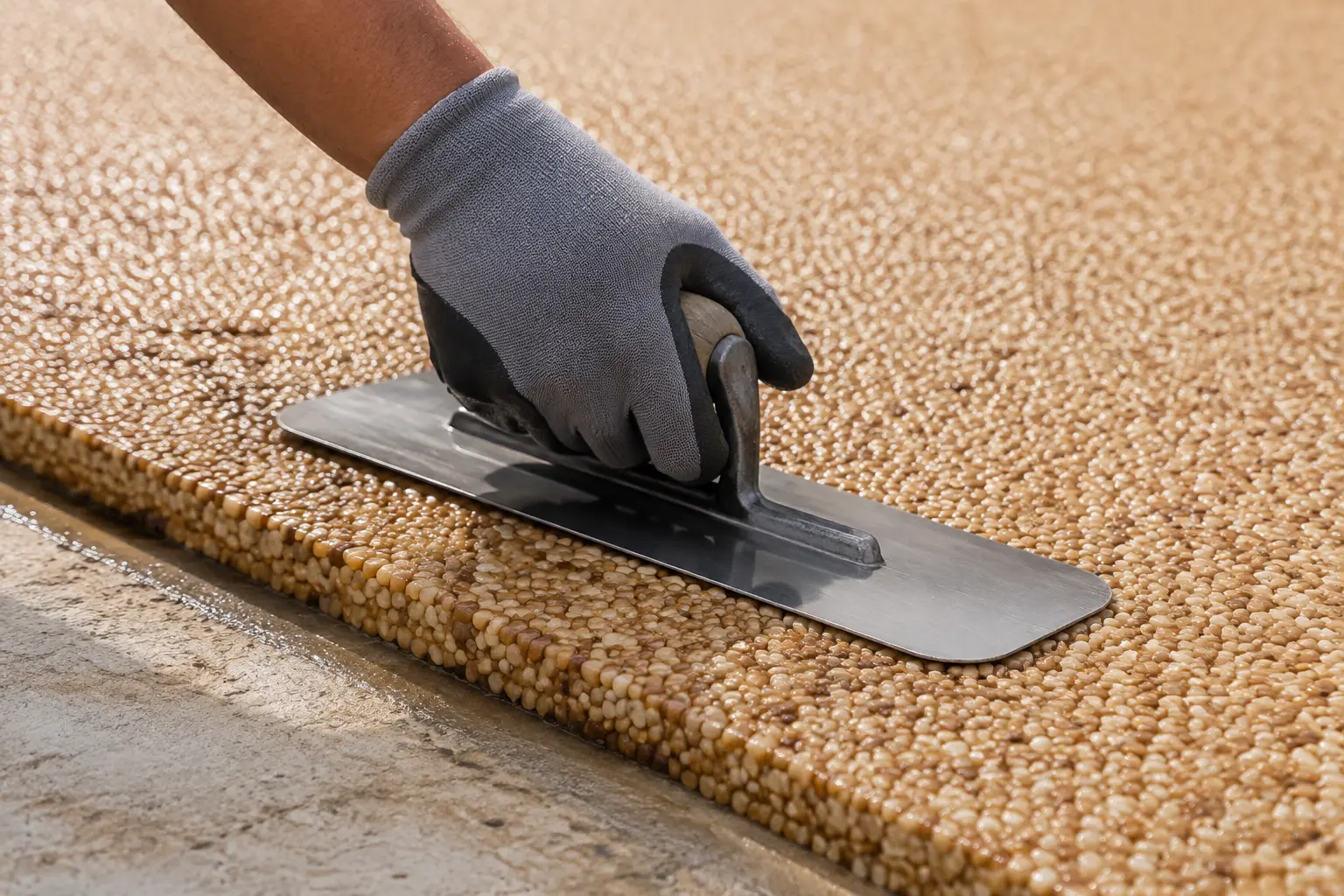
The wet mixture is transferred to the work area, spread and trowelled to the specified depth. Installers work between batches to maintain a continuous edge. Weather and material temperature affect working time, so the crew size and delivery sequence need to match the area.
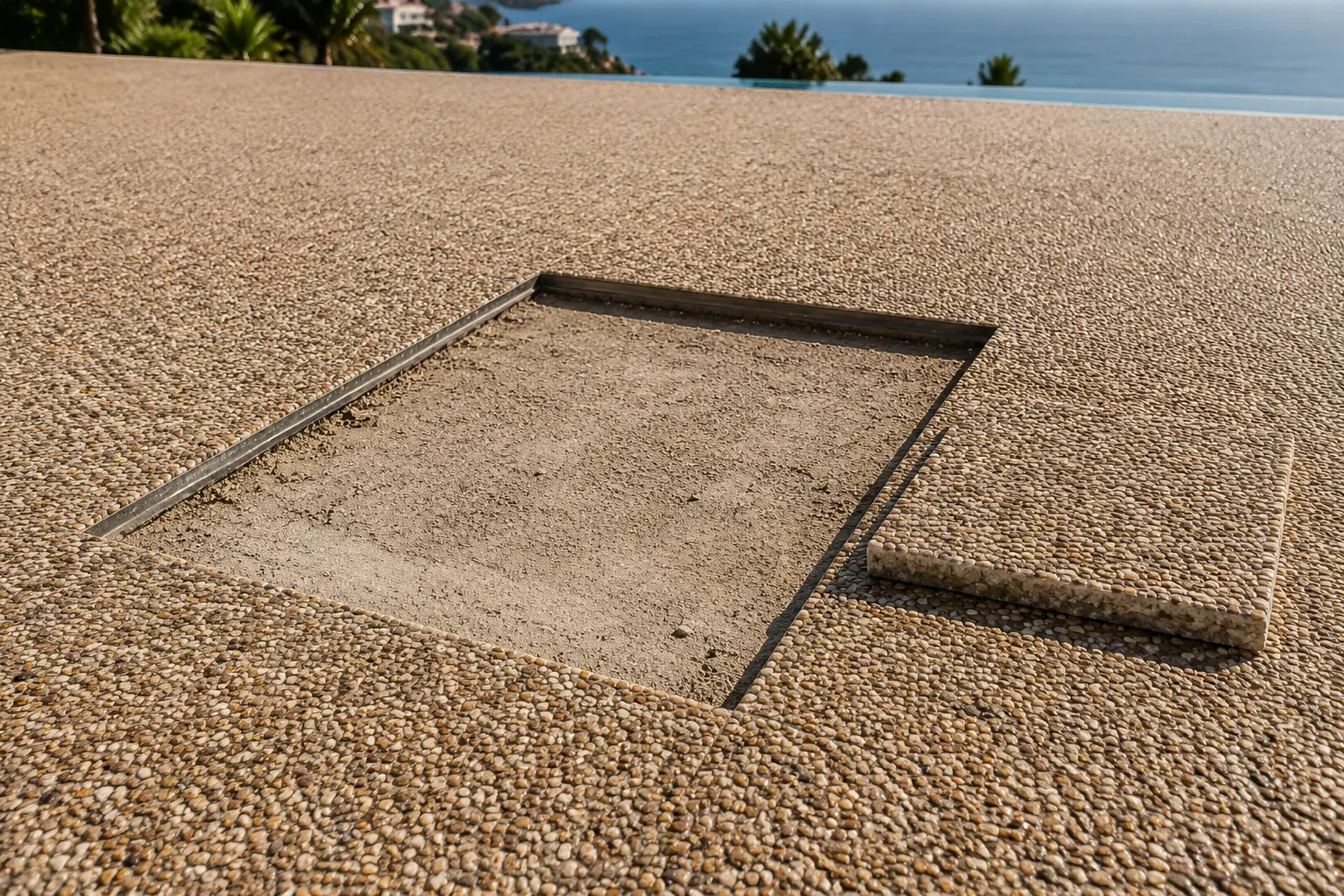
Once cured, the stones form one bound matrix. A small test panel or offcut should reveal aggregate coated and connected below the visible face, not only stones stuck onto a surface film.
This does not mean resin-bound material is structural. It still depends on a stable base, suitable depth, firm edges and a water strategy.
How resin-bonded surfacing is installed
The existing solid base is prepared to provide the condition required by the resin coating. Cracks, joints, moisture and contamination remain important because the system follows the base closely.
Resin is spread at the manufacturer's stated coverage. Dry graded aggregate is then broadcast while the coating remains able to receive it. The installer needs enough stone to cover the resin fully without leaving exposed patches.
After cure, loose excess is removed. The resulting surface is governed largely by the aggregate size and the coating beneath it. It is not a trowelled layer built to the same kind of full depth as resin-bound aggregate.
A bonded finish can provide a pronounced texture and a natural loose-stone appearance. It also needs a drainage route across the surface and details capable of handling any loose stone that is released.
Permeability is a complete-system question
Resin-bound surfacing is often described as permeable because water can pass through the voids between coated stones. That statement applies only when the chosen aggregate blend, binder ratio and finish produce a connected open matrix.
The base determines what happens next. Resin-bound material over dense concrete does not make the concrete permeable. Water reaching the slab must follow its falls to a channel, free edge or another designed outlet.
A fully permeable build-up requires an open bound base and a suitable granular layer below. The design must then establish whether water infiltrates into the ground, is stored temporarily or reaches a controlled discharge. It also needs an overflow route for conditions that exceed infiltration or storage.
Resin-bonded surfacing is generally treated as non-permeable. The supporting base needs falls and surface drainage. Do not accept a permeability claim based on isolated gaps between broadcast stones when the resin coating below forms the operative surface.
Ask the installer to draw the water route through or across every layer. “The resin drains” is not a drainage design.
Texture and use underfoot
Resin-bound surfacing is trowelled to create a relatively even aggregate finish. It is considered for terraces, pool surrounds, paths and accessible routes partly because the continuous surface can avoid loose gravel and repeated paving joints.
The word smooth is relative. It does not mean polished or free of texture. Aggregate grading, finishing and any compatible slip treatment affect the surface underfoot.
Resin-bonded surfacing has a more pronounced exposed-stone profile. That may be desirable where a coarse natural-gravel appearance or high texture is required. It can be less comfortable for bare feet, small wheels or a fall onto the surface, depending on the selected aggregate.
Neither system should be described as “non-slip”. Ask for relevant wet slip-resistance evidence for the exact system and finish. Contamination, slope, wear and maintenance can change performance after installation.
Loose stone and shedding
A correctly mixed and cured resin-bound layer should hold its aggregate within the matrix. Loose stone appearing across the surface can indicate excess broadcast grit, contamination from elsewhere or a defect such as poor mixing, insufficient binder, wet aggregate or unsuitable installation conditions.
Resin-bonded work is intentionally installed with excess broadcast aggregate, which must be removed after cure. Some particles may not contact enough resin to remain fixed. Further shedding can occur as exposed stone receives traffic and weather.
The quotation should explain initial cleaning and whether the client should expect any loose aggregate after handover. Around pools, drains, indoor entrances or delicate adjoining finishes, the practical effect deserves consideration.
Loose stone from a bonded finish is not the same failure mechanism as ravelling from a bound matrix. The repair method and warranty response may differ.
Depth is not described in the same way
Resin-bound aggregate is laid as a mixed wearing course to a system depth selected for aggregate grading and use. Pedestrian, domestic vehicle and commercial loading may require different construction, but no universal depth should be copied into a Spanish quotation without exact system evidence.
Resin-bonded surfacing is a thin coating and broadcast treatment. Its finished profile follows the aggregate size and resin coverage rather than a trowelled structural layer.
This distinction is one reason prices cannot be compared simply by area. A bonded quote may include a much smaller quantity of resin and aggregate because it is proposing a different treatment.
Ask for the installed depth or coverage appropriate to the named system, plus the technical data that supports it. “One coat” and “one layer” do not establish equivalence.
Base requirements still matter for both systems
Neither product repairs a failed base.
For resin-bound work, the installer needs a stable support accepted for the intended loading. New ground construction may include formation preparation, compacted granular sub-base and an open or dense bound course. An overlay requires assessment of cracks, movement, moisture, falls and levels.
Resin-bonded surfacing is applied directly to a suitable solid base. Because it follows that base closely, cracks, joints and local unevenness can remain visible or affect the treatment. Drainage relies on the base falls and outlets.
The quotation should state:
- existing base or proposed new build-up
- preparation and repairs
- primer or interface treatment
- joint and crack detail
- falls and drainage destination
- edge and cover treatment
- intended loading
If those items are absent, knowing whether the finish is bound or bonded is only the first unresolved question.
Does resin-bonded mean a cheaper substitute?
Resin-bonded surfacing may cost less in some circumstances because it uses a thin coating and broadcast aggregate rather than a trowelled mixed layer. That does not make it a lower-priced version of the same product.
It has a different finish, drainage behaviour and maintenance profile. Choosing it only because the quotation is lower can be a false comparison if the client wanted a permeable-capable, even resin-bound surface.
There are also projects where bonded surfacing is specified deliberately. Heritage settings, particular textured routes and some surface-dressing applications may suit its appearance and grip profile. A competent supplier of both systems should be able to explain why one has been selected.
The useful question is not “which is always best?” It is “which method meets the brief and where is that method written into the contract?”
Wording that should appear in a resin-bound quotation
A resin-bound proposal should say more than “supply resin driveway”. Look for:
- the words
resin-boundand a description of aggregate mixed with binder - exact binder manufacturer and product
- aggregate blend, grading and batch weights
- specified installed depth by use
- base construction or overlay assessment
- preparation, primer and joint treatment
- edges, channels, covers and thresholds
- permeable or dense-base water strategy
- weather limits and return-to-service conditions
- maintenance and warranty documents
The use of a forced-action or other system-approved mixer and consistent batch procedure should appear in the method statement. The quotation does not need to reproduce the manufacturer's entire manual but it should commit to the named system.
Wording that should appear in a resin-bonded quotation
A bonded proposal should identify:
resin-bonded,scatter coatorbroadcast aggregatemethod- exact resin coating and coverage requirement
- aggregate grading and broadcast rate
- base preparation and any primer
- removal of excess loose aggregate
- falls, drainage and runoff destination
- expected texture and intended use
- treatment of edges, cracks and joints
- maintenance and expected shedding considerations
- warranty scope
If the contractor describes the finish as permeable, ask for evidence explaining how water passes through the resin coating and supporting base. Do not infer permeability from the stone alone.
Questions that expose an unclear quotation
Ask these questions in writing:
- Is the stone mixed with the resin before laying or scattered over resin on the ground?
- What is the exact product name and manufacturer?
- What installed depth or resin coverage are you pricing?
- What aggregate grading and quantity will be used?
- What base are you assuming and how will it be prepared?
- Is the complete build-up permeable or laid to surface drainage?
- Where does water go after it reaches the surface?
- Should any loose stone remain after handover?
- What traffic and use has the system been accepted for?
- Who issues the warranty and which system does it name?
A contractor should be able to answer the first question immediately. If the later answers reveal a different method from the original sales description, ask for a revised quotation before proceeding.
Warning signs in sales language
Take care when a proposal:
- uses bound and bonded interchangeably
- calls both methods fully permeable
- promises no loose stone while describing a broadcast system
- gives no product or manufacturer
- quotes a very thin treatment as though it were a full resin-bound layer
- relies on a loose aggregate sample without a cured panel
- says the resin will repair cracks or strengthen a failed base
- provides a generic warranty that does not name the installed method
The issue is not always deliberate misrepresentation. The supplier may simply use imprecise terminology. The correction is the same: make the system explicit before comparing price or signing.
Inspecting a cured sample
Ask for a cured sample of the proposed finish. Look at its edge or underside as well as the face.
A resin-bound sample should show stone held through a mixed layer. The surface should reflect the proposed trowelled finish and aggregate blend.
A resin-bonded sample should show aggregate attached to a resin-coated support. Its exposed stones will form a rougher broadcast profile.
The sample establishes appearance and method. It does not prove that your base is suitable, the proposed system meets a wet slip class or the installed project will achieve a particular load capacity.
Where appearance matters, keep the approved sample and record its exact components. Natural aggregate can vary between batches.
Spanish terminology to put beside the English term
There is no single Spanish consumer term used consistently across every supplier. A quotation can remove doubt by pairing the product name with a method description.
For resin-bound, useful descriptive wording is:
árido mezclado previamente con resina y extendido como capa continua
For resin-bonded, useful descriptive wording is:
resina aplicada sobre el soporte con árido esparcido o proyectado encima
These phrases describe what happens. They are more reliable than assuming moqueta de piedra or pavimento de resina always refers to one method.
The binding description, technical sheet and quotation should agree in both languages.
What Stone Carpet Spain means by resin-bound
On Stone Carpet Spain, resin-bound surfacing means a system in which clean dry aggregate is measured and mixed with the specified binder before the material is laid and trowelled over an accepted base.
Any project proposal should identify the exact binder, aggregate blend, intended depth, base, drainage route and installer responsibility. If resin-bonded scatter surfacing is ever proposed for a particular application, it should be labelled separately and explained as a different system.
Clients comparing another quotation can send the method, product data and build-up for review. The first task is to establish what has actually been priced before comparing the figure with a resin-bound proposal.