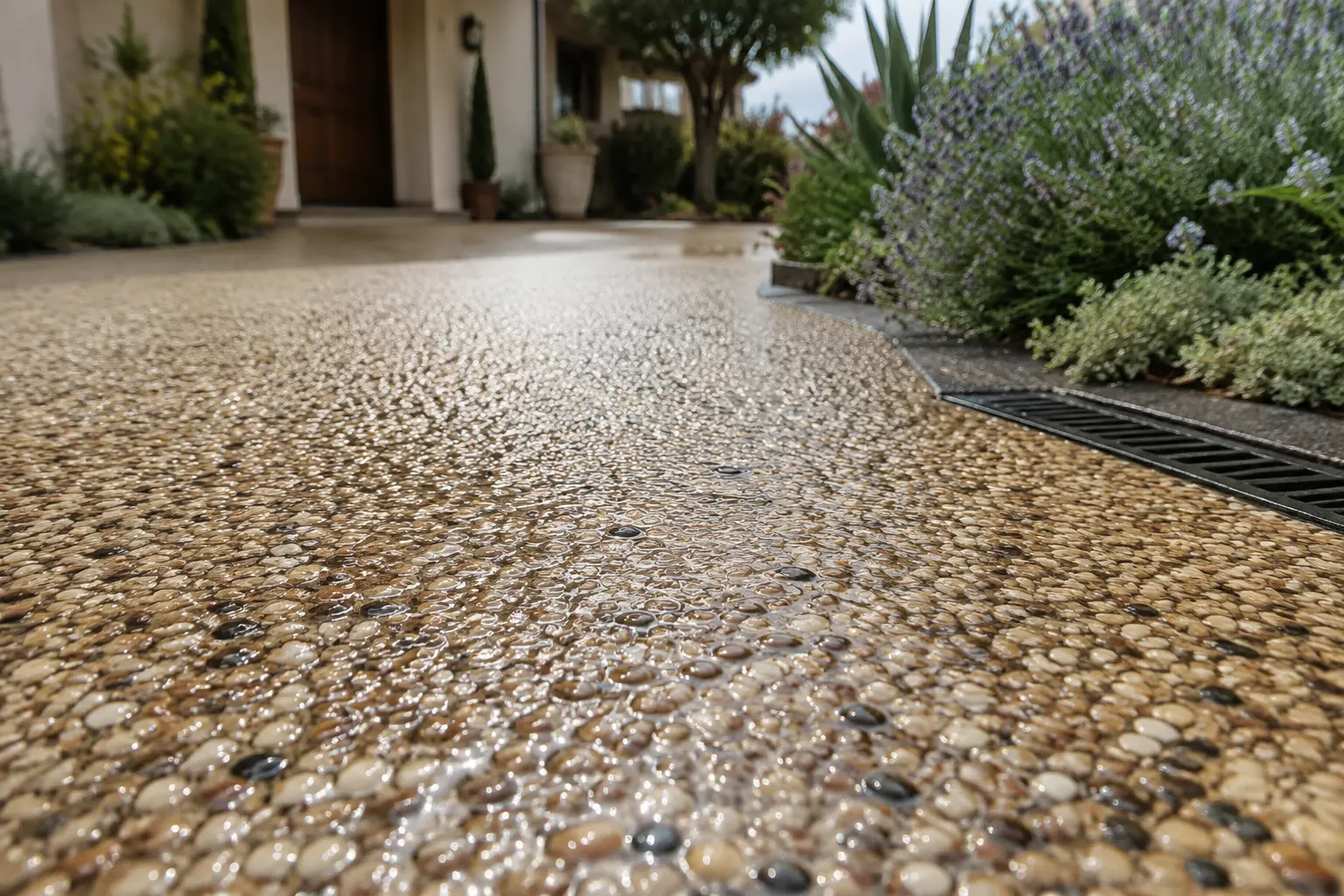
Resin-bound flooring is not automatically slippery when wet. A properly specified system can provide useful slip resistance through its exposed aggregate texture and any compatible additional surface treatment.
It should not be sold as “non-slip”. Water, slope, wear, cleaning and contamination can all change the way a surface performs. A wet pool edge carrying sunscreen presents a different risk from a clean garden path after light rain.
The only defensible answer for a particular project comes from evidence for the exact resin-bound system, the relevant wet test and the condition in which the area will be used.
Why water changes the risk
When a foot or tyre meets a wet surface, the water and anything carried in it can reduce contact with the surface texture. The effect varies with footwear, speed, direction and the material beneath the foot.
Clean rainwater is only one scenario. Around a pool, water can contain sunscreen and body oils. A driveway can hold fuel or fine road dirt. An outdoor kitchen adds grease. Shaded paths may develop algae.
This is why a claim based on the material being “rough” is incomplete. The design needs to consider what will actually make the surface wet and dirty.
What provides grip in a resin-bound surface?
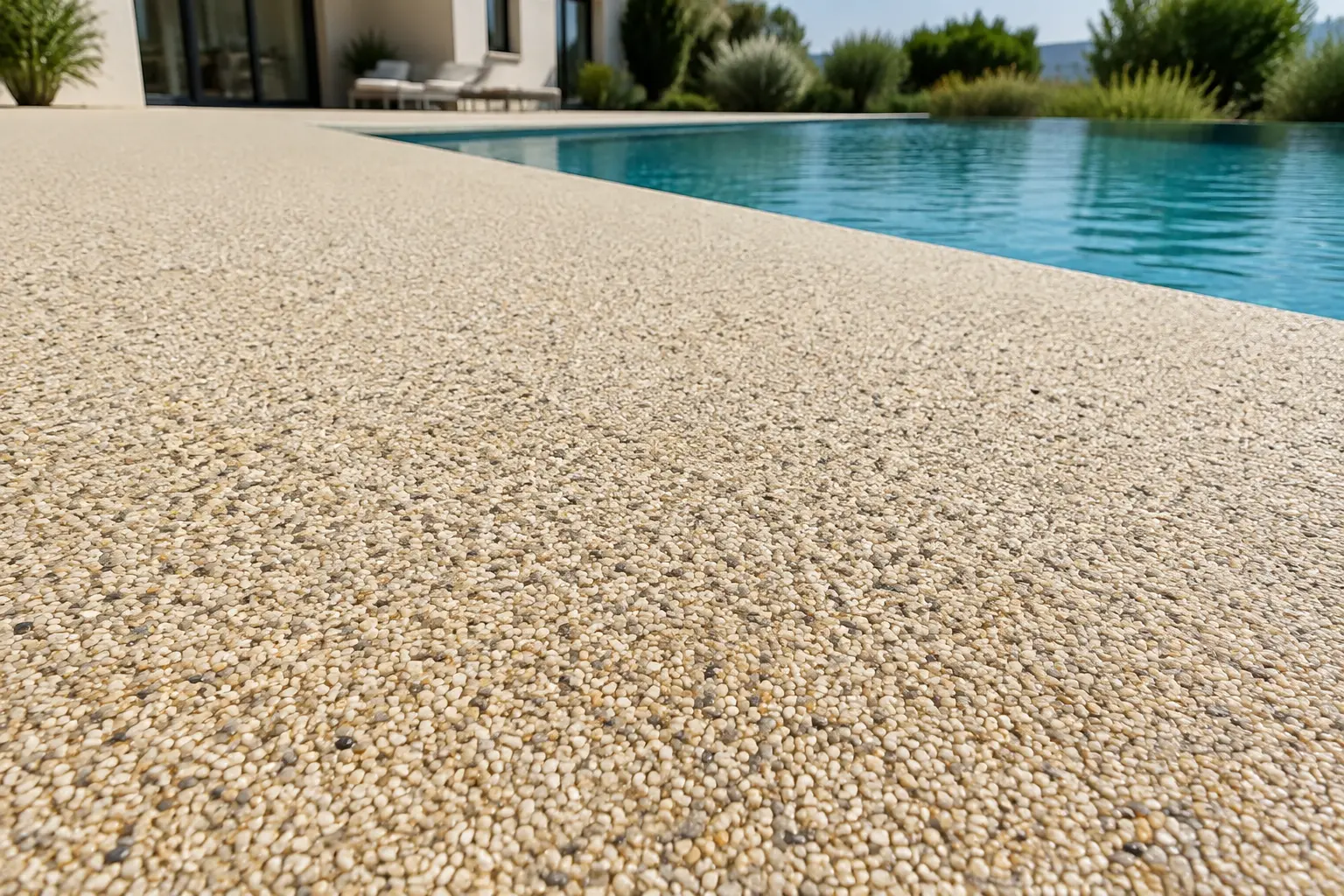
Resin-bound flooring is made from aggregate particles coated in resin and hand finished into a fixed surface. The upper faces of the bound stone create a fine texture rather than the smooth face of a polished tile.
Many proprietary exterior systems also specify a fine material broadcast onto the fresh surface to improve initial slip resistance. Some manufacturers use glass grit for this purpose.
The exact aggregate, grading, resin content, finishing method and additional treatment all influence the result. A test from one configuration cannot be transferred automatically to another.
Why “anti-slip” is not enough
“Anti-slip” and “non-slip” appear frequently in product descriptions, but neither phrase tells a buyer how the surface was assessed.
A useful claim should identify:
- the test method
- whether the test was wet or dry
- the exact product and aggregate blend
- the additional surface treatment
- the measured result or classification
- whether the result applies before or after trafficking
Without this context, the phrase cannot establish suitability for a pool, ramp or commercial entrance.
Permeability helps with water management
Many resin-bound finishes contain connected voids that let water enter the surface. Where the base and drainage design allow that flow to continue, visible standing water can be reduced.
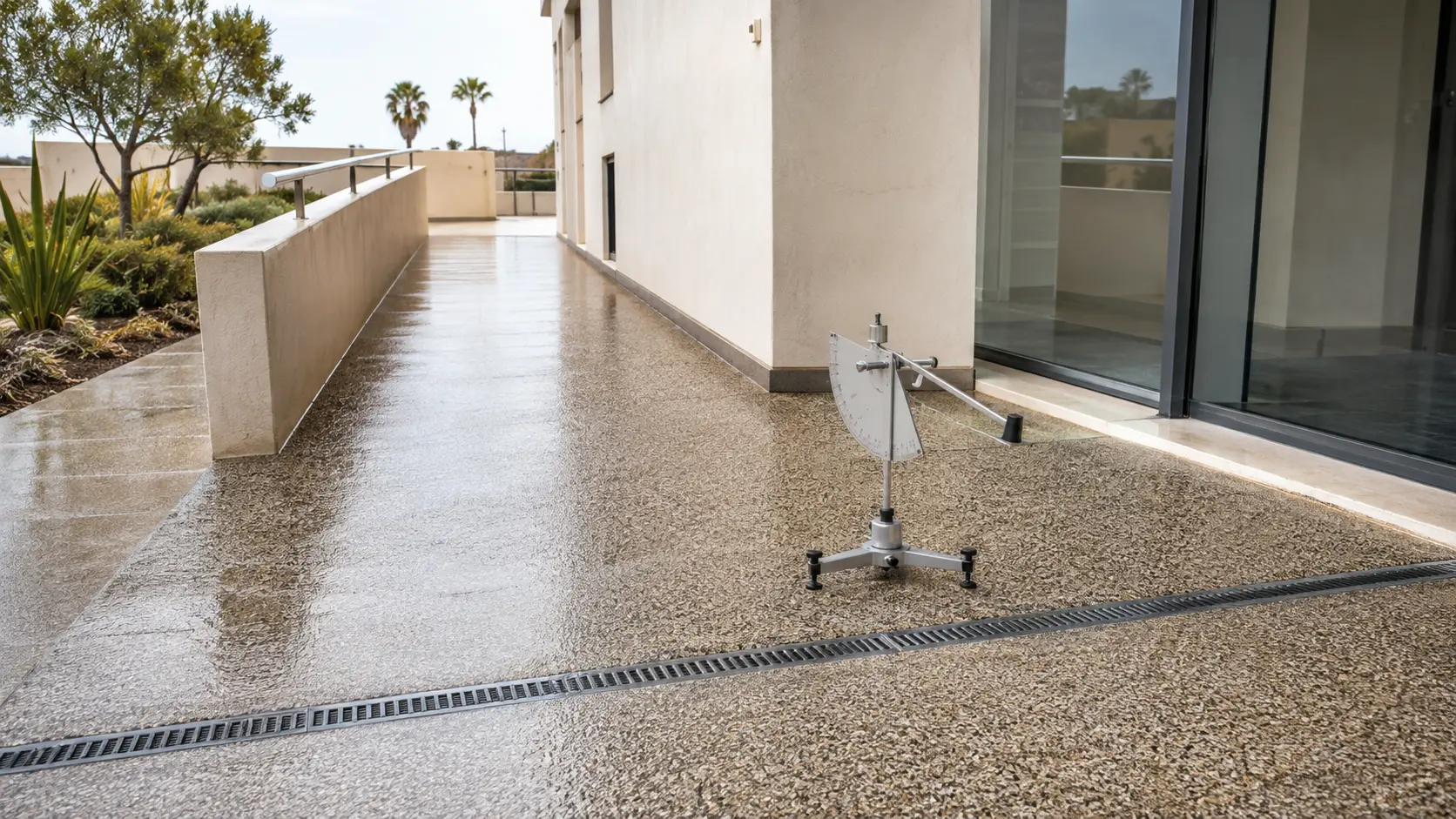
This can support a safer wet-area design, but it does not prove slip resistance. Water may still stand or cross the surface when:
- the base is impermeable and falls are poor
- outlets or channels are blocked
- runoff arrives from a roof or higher paving
- fine dirt has reduced the surface flow
- the area contains a low point
- water arrives faster than the system can discharge it
A porous finish and tested slip resistance are two separate pieces of evidence.
Understand drainage and complete permeability
What happens over concrete?
Conventional concrete forms an impermeable base. Water can pass into the resin-bound finish and then meet the slab below.
The slab must carry water along its falls towards a channel, outlet or open edge. If it is flat or back-falling, water may remain within the surface structure even when the upper layer is porous.
For wet-area safety, the survey needs to identify both the tested finish and the route beneath it. Adding a porous surface cannot correct a concrete slab that directs water towards a door or creates a persistent low spot.
Grit treatment and initial performance
A proprietary grit treatment can increase texture at the surface when applied in the specified quantity and manner.
Too little may fail to achieve the tested configuration. Excess or uneven application can affect appearance, comfort and cleaning. An improvised material may be incompatible with the resin.
Manufacturer guidance also acknowledges that some initial grit treatments wear with trafficking. The exposed bound aggregate may continue to provide texture, but the service condition needs to remain suitable for the project requirement.
The specification should identify the treatment rather than leave it to an informal decision during laying.
Wear changes the surface
Pedestrian traffic, vehicle tyres, cleaning and weather alter the upper surface gradually. The pattern is rarely even. Entrances, turning points, narrow routes and the space around pool steps receive concentrated use.
For a private terrace, ordinary observation and maintenance may be sufficient. Commercial and public areas can require a planned inspection regime and further testing where performance is safety-critical.
A new-sample test should not be described as a guarantee that every part of an installed surface will retain the same value indefinitely.
Dirt can fill the texture
Fine soil, sand and organic material can settle between aggregate particles and reduce the texture available at the contact surface. This can also restrict the entry of water into a porous finish.
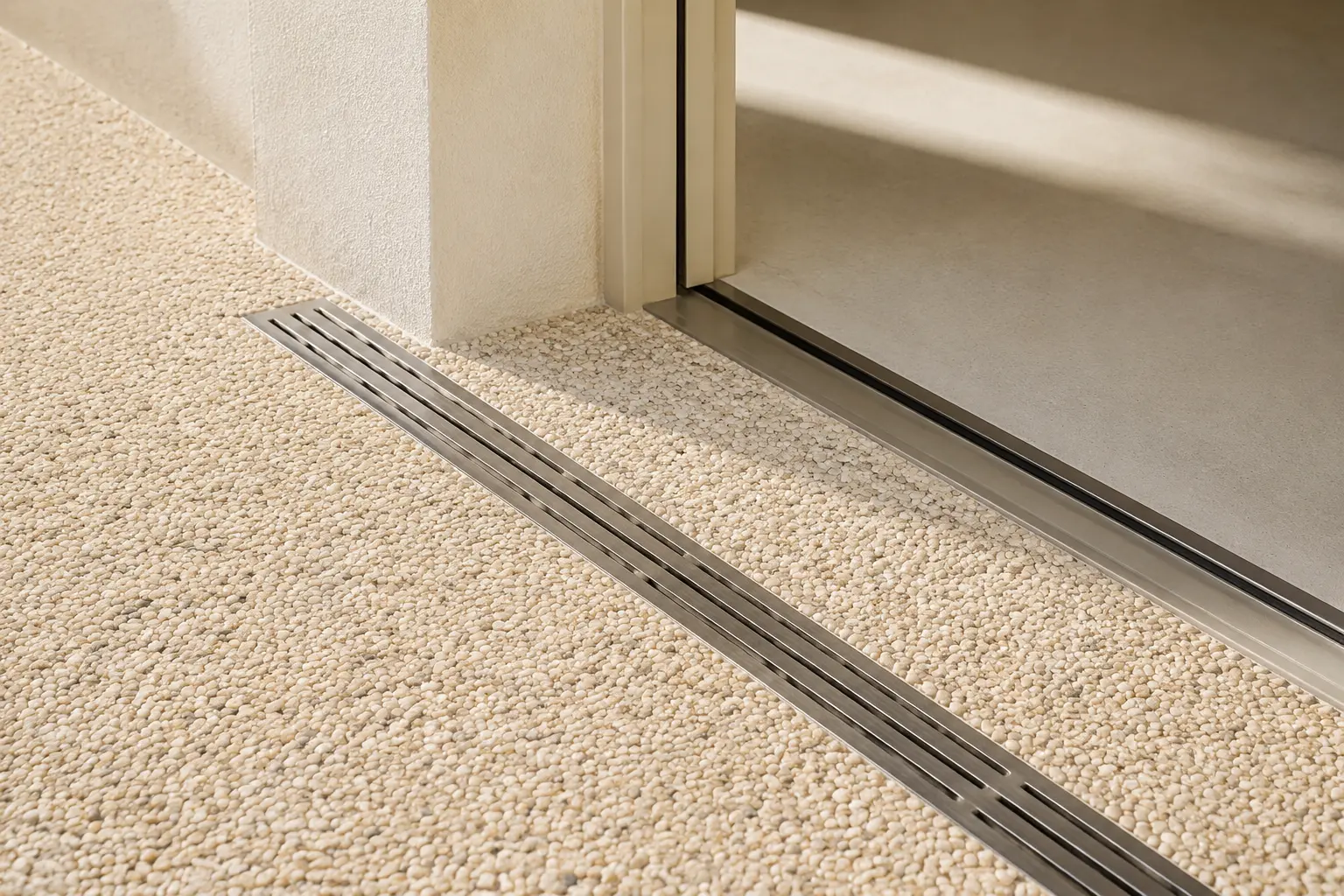
The problem is more likely where:
- bare planting beds drain across the paving
- vehicles carry mud onto a driveway
- leaves and fruit remain in shaded corners
- building work produces fine dust
- irrigation repeatedly washes soil onto the area
Sweeping and compatible periodic cleaning help keep the surface open. Landscape edges and interception channels can reduce the amount of contamination reaching it in the first place.
Algae and shaded areas
Shade does not make a resin-bound surface slippery by itself. Persistent damp and organic material can allow algae or moss to establish, especially where drainage or cleaning is poor.
North-facing wall edges, covered terraces, areas beneath planters and water from irrigation deserve attention. A surface may dry in the centre while remaining damp around its perimeter.
Organic growth should be treated using a method compatible with the named resin system. Strong chemicals or excessive pressure can damage the finish or leave residues that create another hazard.
Pool surrounds
Pool areas are the most obvious wet-use application, but rain is not their main challenge. People leave the water barefoot. Splashing is frequent and sunscreen, body oils and pool-treatment residues can reach the surface.
The specification should consider:
- wet slip-resistance evidence for the exact system
- routes between the pool, steps, shower and building
- falls, channels and drainage capacity
- copings, skimmers and service covers
- barefoot comfort and surface temperature
- cleaning products and frequency
- how furniture affects inspection and cleaning
A surface that performs well in a clean wet test still needs sensible operation around the pool.
Plan a resin-bound pool surround
Outdoor showers
Showers add soap, shampoo and personal-care products to the water. These can reduce grip and leave a film if drainage and rinsing are inadequate.
An exterior resin-bound product marketed for pool surroundings should not be assumed suitable for a shower without relevant evidence. The drain position, slope, barefoot use and cleaning regime all need consideration.
Where Spanish building requirements apply, showers appear explicitly within the highest exterior and wet-area class in the relevant DB-SUA location table.
Terraces used for outdoor dining
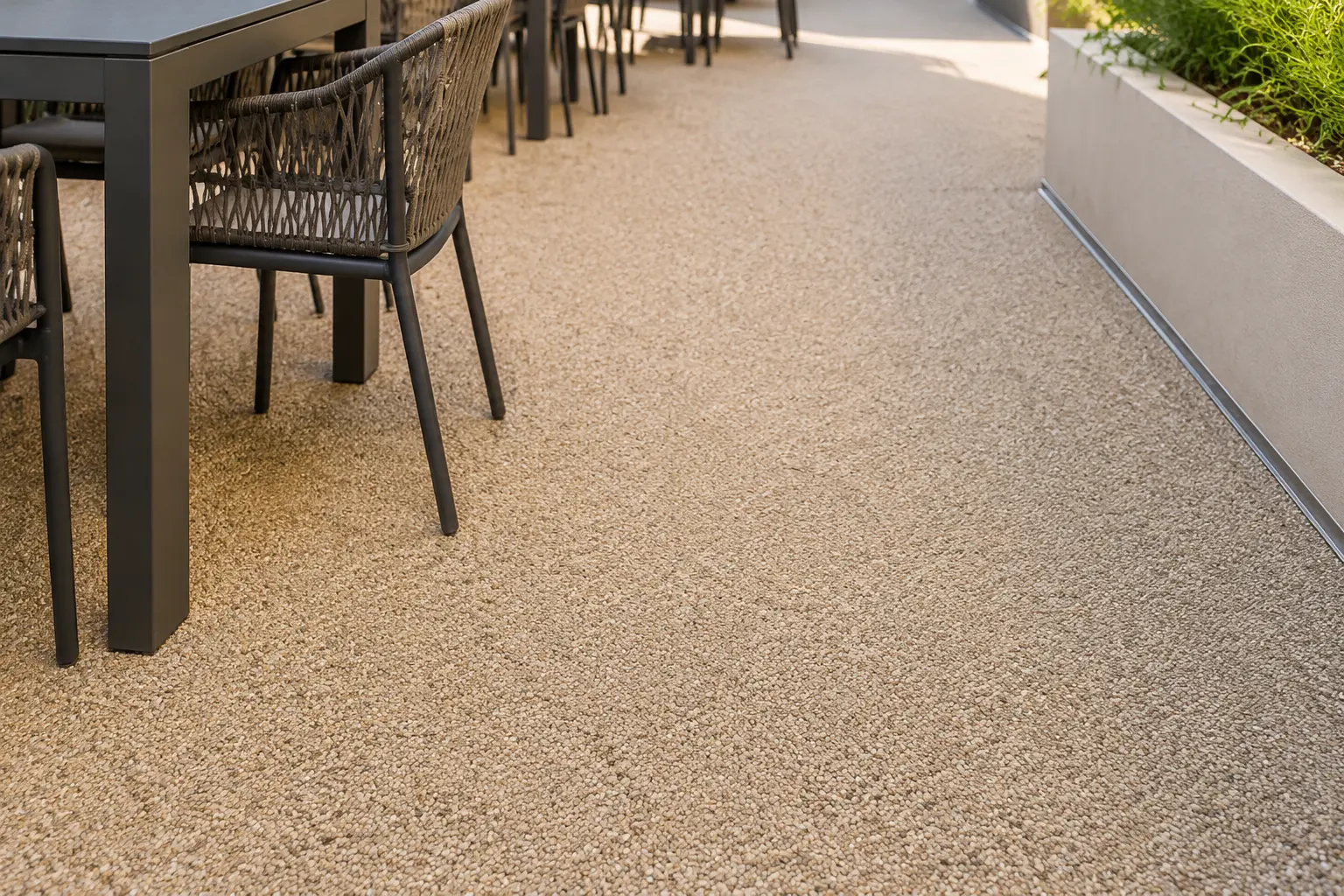
Food oil, drink spills and barbecue grease create a different contamination profile from pool water.
A porous finish should not be allowed to absorb or spread a spill while the cleaning response is delayed. The system supplier's instructions should explain how common contaminants are treated and which chemicals must be avoided.
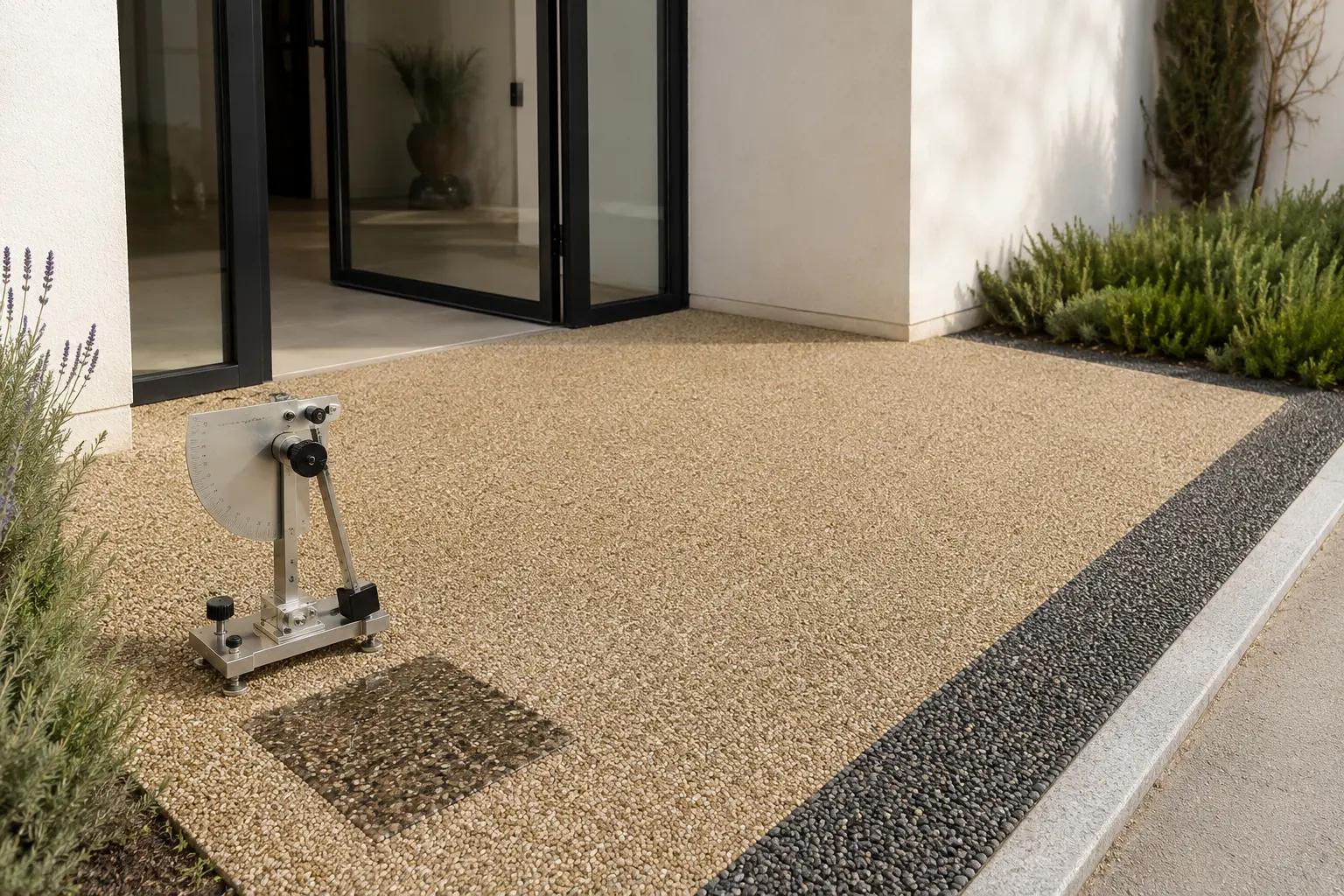
Under tables and outdoor rugs, debris can remain unnoticed. Moving furniture during routine cleaning makes the surface easier to inspect.
Driveways and garage entrances
Vehicle areas combine wet pedestrian use with oil, fuel, tyre residue and fine road dirt. Slopes at garage entrances or gates can increase the risk.
The surface and base need to be suitable for vehicle loading as well as pedestrian grip. A finish chosen for a barefoot pool area is not automatically the right specification for turning vehicles.
Channels should intercept water where necessary without creating a trip or weak edge. Spills need prompt treatment under the product maintenance guidance.
Ramps and steps
A slope changes how a user loads the surface. Water can also flow across a ramp or collect at its lower landing.
The project should record the gradient, traffic direction, user group and wet exposure. Handrails, accessible-route design, drainage and visual contrast may be relevant alongside slip resistance.
Steps need consistent geometry and properly detailed nosings. Adding an overlay must not create uneven riser heights or obscure a movement joint.
For regulated, public or accessible routes, a competent professional should assess the complete design.
Commercial entrances
The risk at an entrance often spans several materials. Users move from exterior paving through a covered threshold and onto an internal floor while carrying water on their footwear.
Mats, channels, door clearances, lighting and cleaning all affect the transition. A compliant or tested exterior product does not make the internal route safe by itself.
Commercial operators should define who responds to rain, spills and blocked channels during opening hours. Maintenance carried out only after closing may not address peak risk.
How Spain's CTE treats slip resistance
Spain's Documento Básico SUA addresses safety in use and accessibility. Within the stated scope of Section SUA 1, floors are classified by their resistance-to-sliding value, Rd, using the wet pendulum method referenced as UNE 41901:2017 EX.
The published bands are:
- Class 0: Rd up to 15
- Class 1: Rd greater than 15 and up to 35
- Class 2: Rd greater than 35 and up to 45
- Class 3: Rd greater than 45
The location table identifies exterior areas, qualifying pool areas and showers as Class 3 for the uses covered by the section. It also states that the required class is to be maintained during the life of the floor.
The provisions have a defined scope, including listed public residential, healthcare, educational, commercial, administrative and public-assembly uses. They should not be quoted as a blanket legal classification for every private domestic patio.
Read the detailed slip-resistance and Spanish requirements page
Does a private pool need Class 3?
There is no responsible one-line answer for every private pool project.
The CTE text, the nature of the work, property use and local approval route determine formal applicability. A hotel, residential community and single private home do not necessarily share the same compliance position.
The practical wet barefoot risk remains even where a particular table is not directly applicable. A project professional should determine the requirement when compliance is being declared.
The surfacing supplier should provide evidence for the system rather than make legal conclusions about the building.
A test number needs context
Manufacturers may publish pendulum or skid-resistance results. A number cannot be used safely unless the report identifies the test method, condition and exact surface tested.
Check whether the result describes:
- wet or dry conditions
- an initial untrafficked sample
- a particular aggregate size and blend
- a specified grit treatment
- pedestrian or vehicle interpretation
- a laboratory sample or an installed area
Different test methods and classifications are not interchangeable. A UK product statement does not automatically prove compliance with a Spanish project specification.
Can the installed surface be tested?
On-site testing may be appropriate for safety-sensitive commercial, community or public areas. It can provide evidence about the actual surface at a stated time and condition.
The test plan needs a recognised method, competent operator and representative locations. High-use paths, slopes, shaded areas and repaired sections may deserve separate consideration.
Testing does not replace maintenance. It is one part of confirming that the specified performance has been delivered or retained.
Cleaning without leaving a slippery film
The cleaning method should remove contamination and leave no detergent or coating residue.
Follow the system supplier's maintenance information. Controlled pressure washing may be permitted, with care around edges, joints and repairs. Aggressive solvents, acids and generic sealers can damage resin or change surface behaviour.
Rinse thoroughly and make sure channels and outlets remain clear. Cleaning water should travel to an appropriate destination rather than carry contaminants across another walking route.
Can a sealer make resin-bound flooring slippery?
Any coating can change the texture, gloss and way water interacts with the surface. It may also reduce permeability.
Some manufacturers supply compatible rejuvenating treatments for particular systems. Those products should be assessed for the application and may require renewed slip-resistance evidence in a regulated area.
A general-purpose clear sealer should not be applied merely to make cleaning easier. The original surface condition and reason for treatment need diagnosis first.
Repairs can create a different texture
A local repair may use the same named blend yet finish differently because of batch variation, resin age, trowelling and surrounding wear.
The patch should be checked for secure edges, consistent level and appropriate texture. In a commercial or regulated wet area, the repair needs to remain within the project's performance and maintenance approach.
An invisible colour match and an identical slip result should not be promised without evidence.
Warning signs after installation
Investigate the surface if:
- water begins standing where it previously drained
- algae returns repeatedly after cleaning
- aggregate becomes loose
- a glossy or smooth traffic path develops
- a coating peels or changes colour
- repairs sit proud or below the surrounding area
- users report a repeated slip location
- channels overflow or remain blocked
The cause may lie in contamination, wear, drainage, installation or the base. Treating every issue with stronger pressure washing can make matters worse.
What should a wet-area quotation include?
The proposal should identify:
- intended use and likely contaminants
- slope, falls and drainage route
- exact resin system and aggregate grading
- wet slip-resistance evidence and test method
- additional surface treatment
- installation quality controls
- cleaning and maintenance instructions
- inspection or retesting requirements where relevant
- responsibility for Spanish project compliance
“Non-slip finish included” is not enough for a pool, ramp or public entrance.
Seven questions before accepting the specification
- What makes this area wet and what contaminants are likely?
- Which exact surface system has been tested?
- Was the relevant result obtained in wet conditions?
- Does the installation include the tested grit or finishing treatment?
- Where will water go through and across the build-up?
- How will wear, cleaning and repairs be monitored?
- Who has determined the applicable Spanish requirement?
These answers are more useful than a general assurance that resin-bound flooring is safe around water.
Request a wet-area review
Send the project location, intended use, approximate dimensions, slopes and photographs of drains, thresholds, pool details or access routes. Include any known contamination or standing-water problem.
We can help identify the product evidence and site questions that need resolving before the surface is specified.
Request a wet-area specification review